
Asphalt Art FAQ
Tips and answers to common inquiries about creating asphalt art, expanding on our Asphalt Art Guide.
U.S. Design Guidelines on Asphalt Art
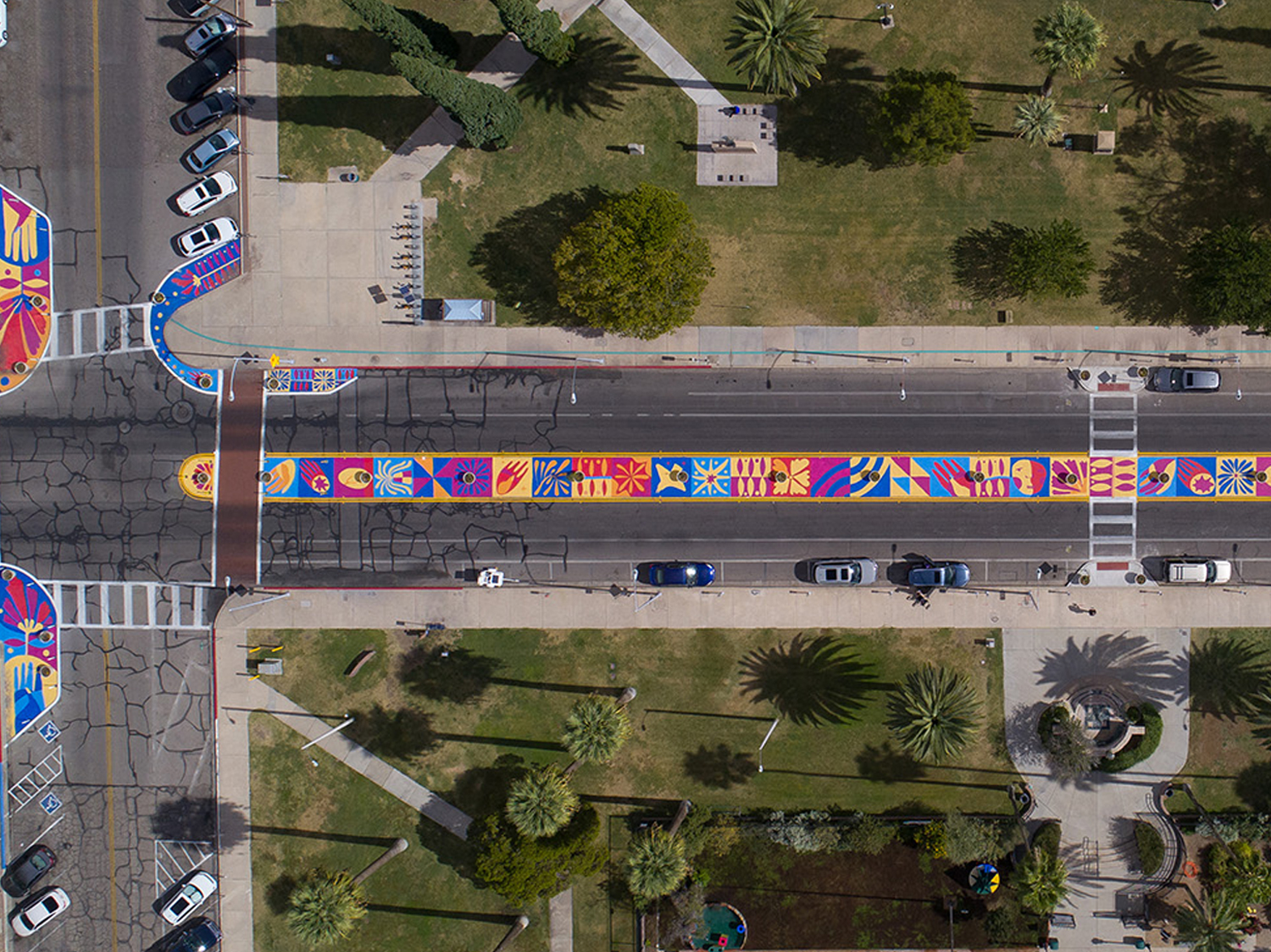
For those interested in proposing, designing, implementing, or approving arts-driven street design projects, the headline is that the 11th edition of the Manual on Uniform Traffic Control Devices (MUTCD) issued in December 2023 explicitly allows asphalt art projects on United States roadways. The Manual rightly recognizes the many ways cities have already added art to their streets, including curb extensions, at the midblock, in the center of intersections, and in crosswalks.
This interpretation of the latest MUTCD was based on a review by staff at Bloomberg Associates, the National Association of City Transportation Officials (NACTO), and Street Plans Collaborative.
Read more in an op-ed from The Washington Post written by Bloomberg Associates’ Janette Sadik-Khan and Kate D. Levin highlighting this news on asphalt art and the updated MUTCD.
Where can we create asphalt art?
Section 3H.03 (pages 622-623) of the MUTCD allows “aesthetic surface treatments” (aka asphalt art):
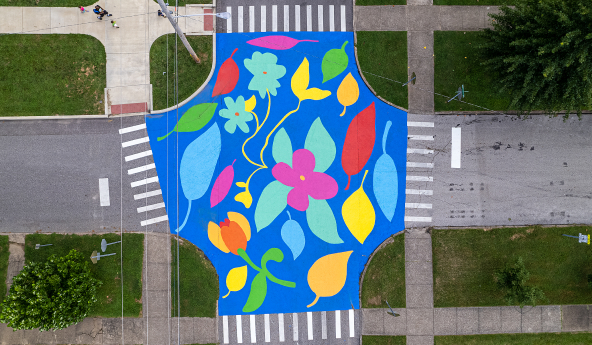
Inside intersections
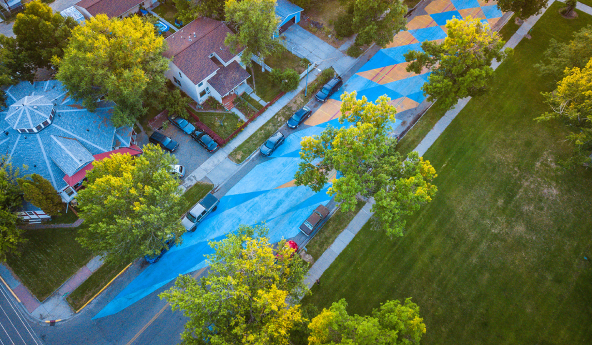
Midblock
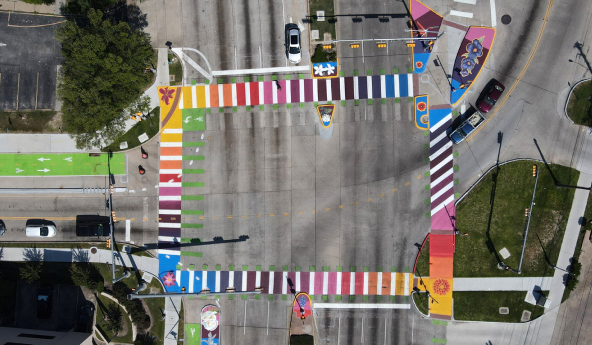
As part of crosswalks
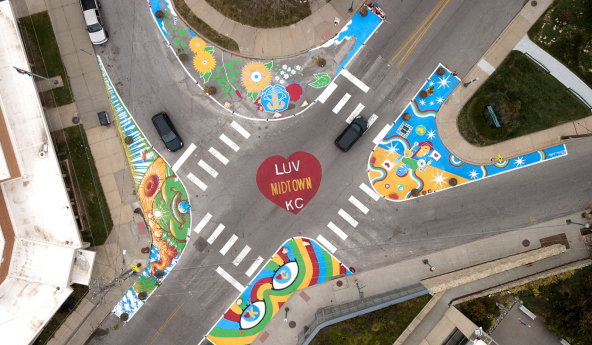
In quick-build curb extensions, as well as other pedestrian-only areas like plazas
Note that these treatments are allowed both in the roadway, including crosswalks, inside intersections or midblock, and outside of the roadway (as the MUTCD defines it), for instance in pedestrian-only areas such as painted sidewalk extensions. In either case, a critical defining characteristic of asphalt art is that it is not intended to communicate regulations, warnings, guidance, or other information to road users and is thus not considered a traffic control device.
Also, the new 11th Edition of the MUTCD clarifies that roadway-level sidewalk extensions or other pedestrian-only areas are not actually “roadway” space – they are extensions of the sidewalk itself (see Section 3J.07). As long as the art inside the sidewalk extension isn’t retroreflective, artists have full creative freedom there. Just be sure to delineate this space with a white line. And be sure to end the crosswalk at the curb extension and add a tactile detectable warning surface or other indicator for the transition from the roadway to pedestrian space. See the AAI projects for myriad design ideas for tactical curb extensions and the NACTO Urban Street Design Guide for an overview of other roadway-reclamation possibilities.
What do we need to keep in mind with my design?
As cities have already demonstrated, there’s a whole world of design options that can be approved for use in streets.
That said, there are some parameters:
- Don’t cover up or make it difficult for pedestrians who are blind or low-vision to use the tactile bumps (Detectable Warning Surfaces) for the crosswalk.
- Your art cannot be retroreflective.
- Don’t include any any signs, markings or other traffic controls (a “symbol” as defined by the MUTCD) or official agency logos (an MUTCD “pictographs”). You’ll see that the guidance also discourages “illustrations” which isn’t formally defined but is used to refer to drawings that explain text, so this wouldn’t impact many, if any, asphalt art projects.
- You can’t include any advertising.
- Make sure your design and its colors can’t be easily confused for other types of markings on the street, like a bike lane or the double-yellow centerline.
- For artwork in crosswalks, the MUTCD suggests muted colors or “earth-tone equivalents.” Keep in mind, though, that this isn’t an explicit requirement; it doesn’t provide an exhaustive or exclusive list of options; and there are many colors found in nature that qualify as earth tones, so that still provides a lot of avenues for expression.
- Be sure to avoid solid swathes of colors that are recognized by MUTCD as official colors for other purposes (bike lane green, bus lane red, ADA blue). Outside of these, there is broad latitude for colors and designs.
- Check your local and state transportation regulations to make sure you’ve met all the requirements.
These rules are easy to work within, and it only takes a glance at the many Asphalt Art Initiative projects to see many examples of designs that look nothing like any traffic sign, traffic signal or MUTCD marking. Common asphalt art materials aren’t retroreflective, either (see this list of commonly used paints).
That means there’s a whole world of design options that can be approved. Unless your project included painting a giant stop sign in the middle of the street, you should be able to find a way to make it work with the new MUTCD.
How do we make sure my crosswalk art is still accessible for people with disabilities?
Crosswalks need to be navigable by all kinds of people, including those who are blind or low-vision and those who use mobility aids like wheelchairs and canes. For all crosswalks, the tactile bumps on the curb ramp need to stay visible and detectable. If your art covers the ramp, be sure not to cover the detectable warning surface (the strip of bumps at the bottom of the ramp), and be sure to use colors that don’t blend in with that area (usually a bright yellow or rusty red color). The Manual provides some new guidance to ensure the colors in your art contrast well with the white lines of the crosswalk itself.
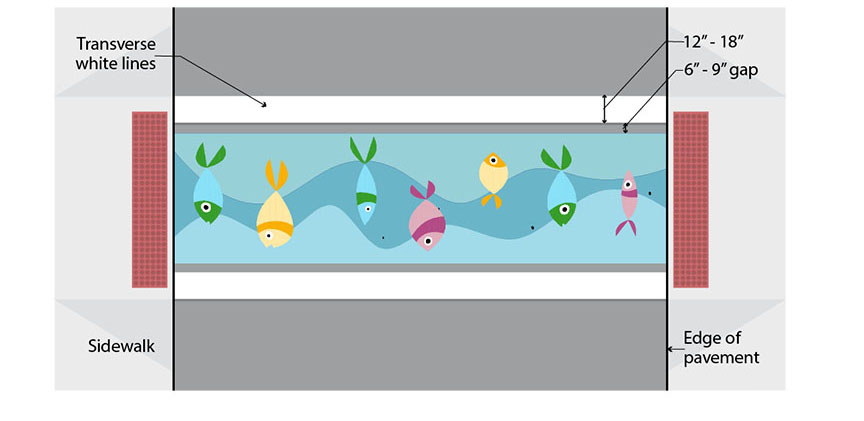
- For basic crosswalks that just have two lines from one curb to the other (a “transverse” crosswalk): Leave at least 6” of uncolored asphalt next to the white crosswalk lines if you’re using pale or light colors that can be easily mistaken for white.
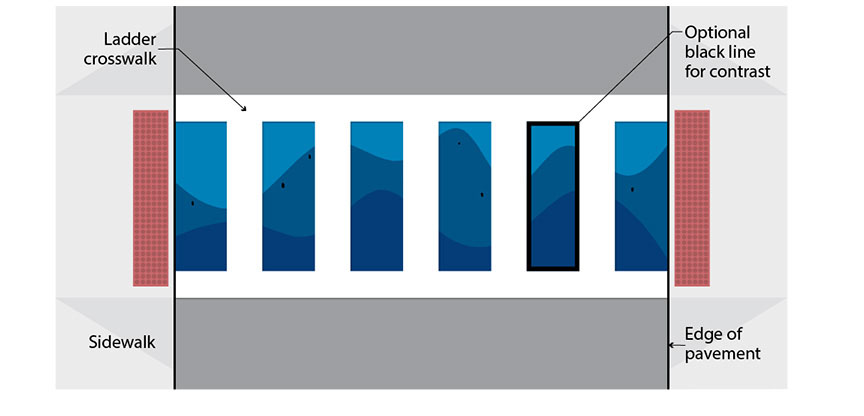
- For crosswalks that have both lines and bars (“ladder” or “perpendicular” crosswalks): Fill in all the blank space between the ‘rungs’ of the ladder with bright colors that contrast with white. Like basic crosswalks, be sure to leave 6” of blank asphalt next to the crosswalk lines if you’re using pale or light colors that don’t contrast with white.
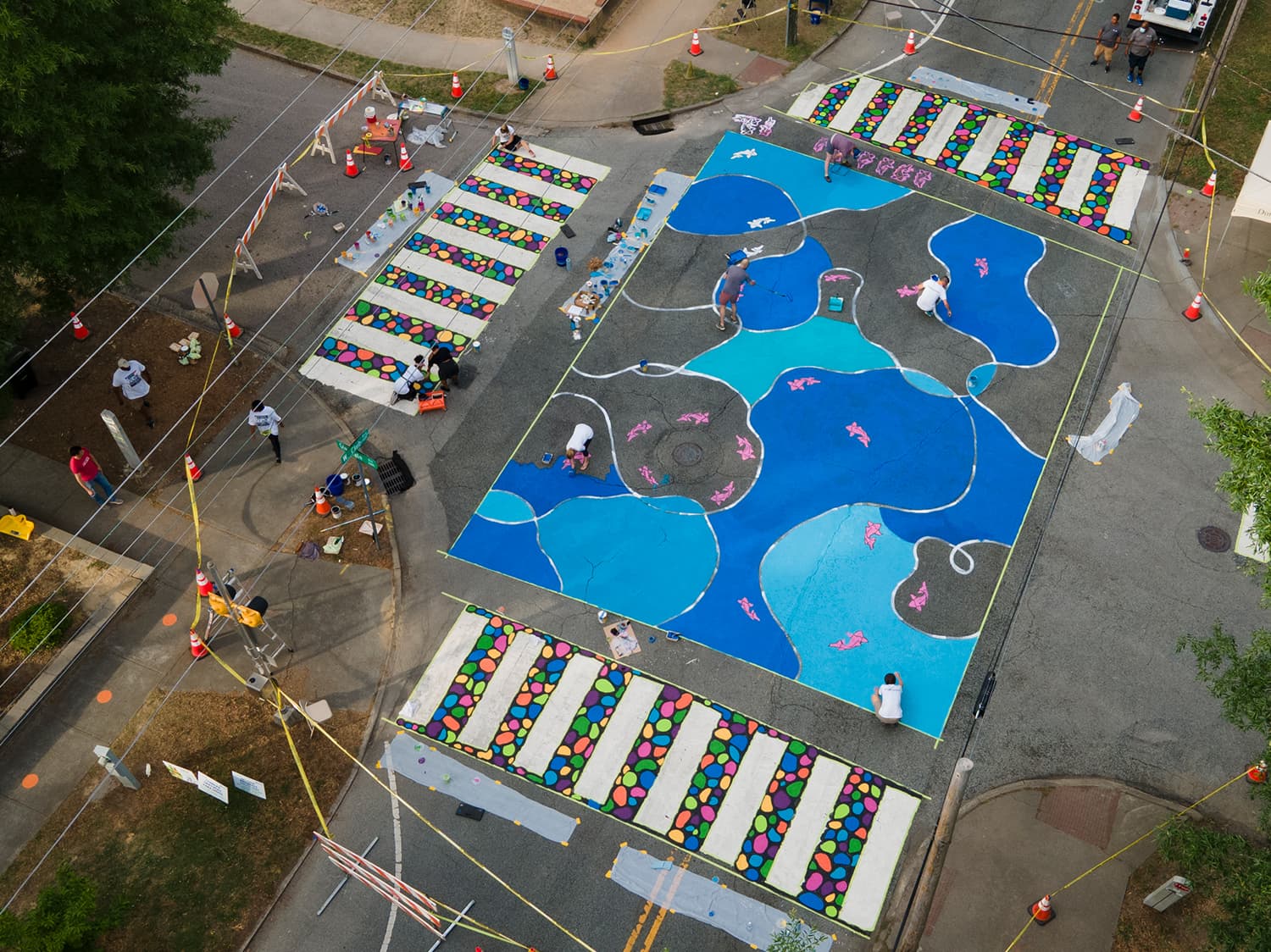
- For crosswalks that have been marked with bars only (also known as “continental” or “zebra” crosswalks): Art can fill all the blank space between the white lines.

We’re using “daylighting” to improve visibility at intersections. Can we add art there?
Yes. “Daylighting” is often kind of boring: some white lines in the street accompanied by signs that restrict parking. This area is perfect for art! Much like sidewalk extensions, the new edition of the MUTCD clarifies that this space isn’t actually “roadway” space – it’s technically part of the sidewalk (see again Section 3J.07). Just make sure that transportation staff use white lines to distinguish this space from the street.
And again, get inspired by Asphalt Art Initiative projects across the country and use the NACTO Urban Street Design Guide for an overview of other roadway-reclamation possibilities.
What happens next?
Though not mentioned in the MUTCD itself, the rulemaking document – 84 pages in the Federal Register explaining what changed in this version of the MUTCD and why – gives a few additional hints. For one, it cites the Asphalt Art Safety Study completed by Bloomberg Associates, Sam Schwartz, and Street Plans that shows these types of projects seem to do no harm. It also cites an underway (though still under wraps) study the Federal Highway Administration is itself conducting and invites others to contribute to the body of knowledge.
We couldn’t agree more that additional studies of asphalt art are warranted and helpful. We hope our community can further study everything from the best design and material choices, to the relative benefits of aesthetic treatments versus traditional geometric changes, to how people with vision impairments or members of other diverse communities interact with asphalt art.
Everyone deserves safe and welcoming streets, where simple design strategies and vibrant art inspire a sense of community. As traffic crashes continue to injure and even kill increasing numbers of people just trying to get around on foot, we cannot afford to leave any tools untouched. With this newest edition, the palette of what’s possible on our streets looks a lot brighter.



How can I convince a reluctant city engineer to pursue asphalt art?
A common reason for resistance to asphalt art projects has to do with earlier versions of federal guidelines known as the MUTCD. Thankfully this guidance has been updated in the new 11th Edition, which now explicitly allows asphalt art projects. See the “U.S. Roadway Design Guidelines” section of this FAQ for more information that you can share with your city engineers.
It should also be noted there is no concrete data or evidence to support the assertion that asphalt art is unsafe or yields a false sense of security for pedestrians and drivers. To the contrary, our recent Asphalt Art Safety Study of 22 asphalt art projects in the U.S. found notable increases in safety conditions, including:
- 50% drop in the rate of traffic crashes involving pedestrians or cyclists
- 27% increase in the rate of drivers yielding to pedestrians with the right-of-way
For examples of projects with documented safety improvements, see the metrics on our Kansas City and Pittsburgh project pages.
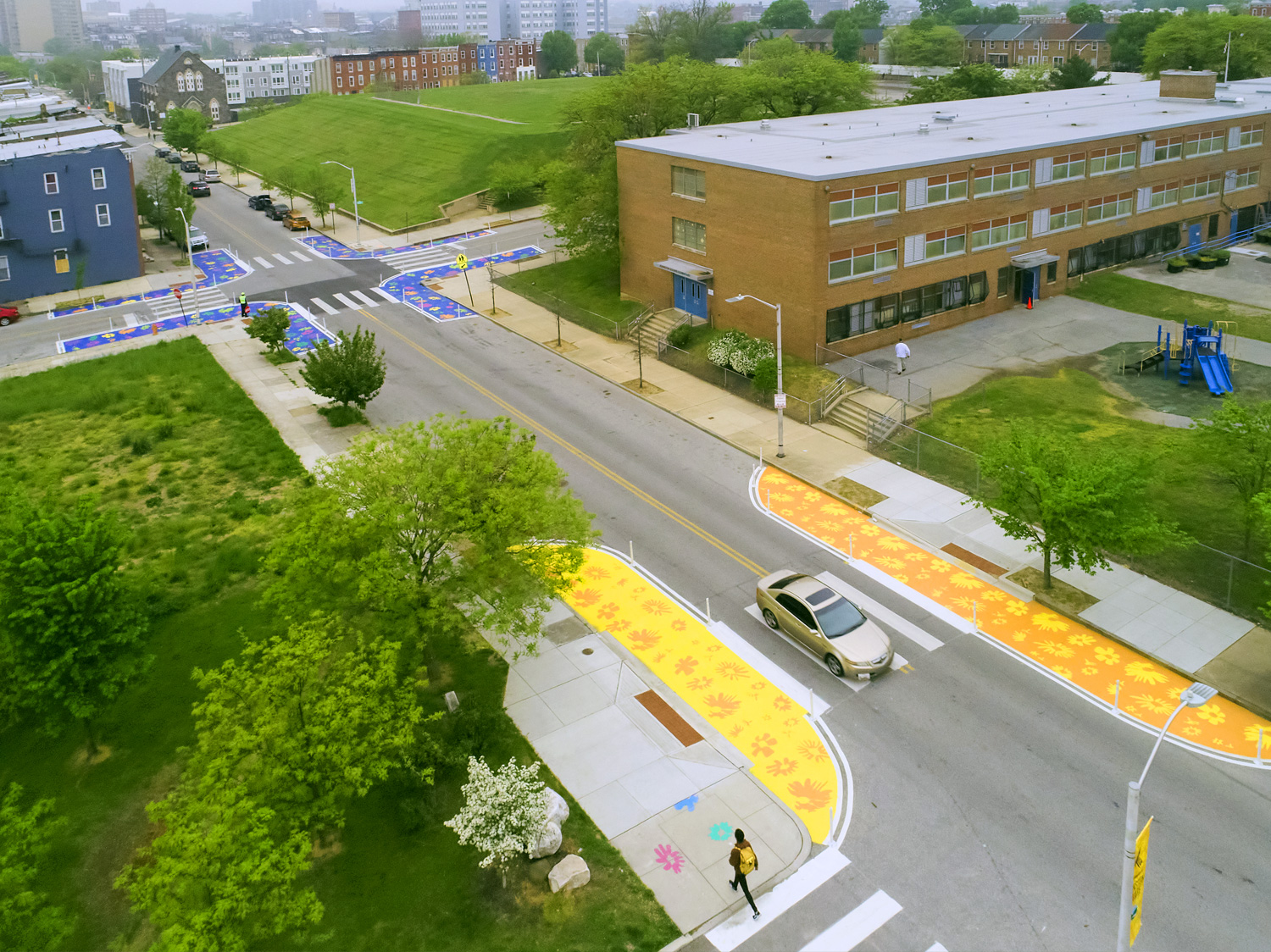
Accordingly, city engineers should be encouraged to set parameters that they find acceptable regarding iconography and colors. For example, many projects avoid conventional traffic control colors, such as yellow and red, and avoid using words or symbols that may convey meaning or be confused with traffic control. Working with a city engineer to set such parameters frequently allows projects to move forward while addressing local concerns.
Project partners can also make the case that asphalt art projects are temporary and removable if safety problems should arise. With a proper evaluation and monitoring plan, the city can have a clear and predictable protocol for mitigating any safety concerns while allowing the project to proceed.
Read more in the Asphalt Art Guide
See pages 86-87 for reference
How should I select an artist?
There are several common approaches to including artists in the asphalt art process. In some cases the artist is a core part of the project team from the beginning. This is most often the case when an arts organization or design firm is one of the main project partners.
If an artist is not initially part of the project team, here are some ideas:
Consider working with a local artist who could be identified through a local arts agency or council, arts service organization, or cultural or educational institution. These organizations can also help develop and publicize an open call for artists that can reach a broad pool of local talent.
If an even wider net seems appropriate, an open call or RFP can be issued and promoted with the help of national arts publications and service organizations. If proposals are solicited from artists outside your region, be prepared to support a travel budget.
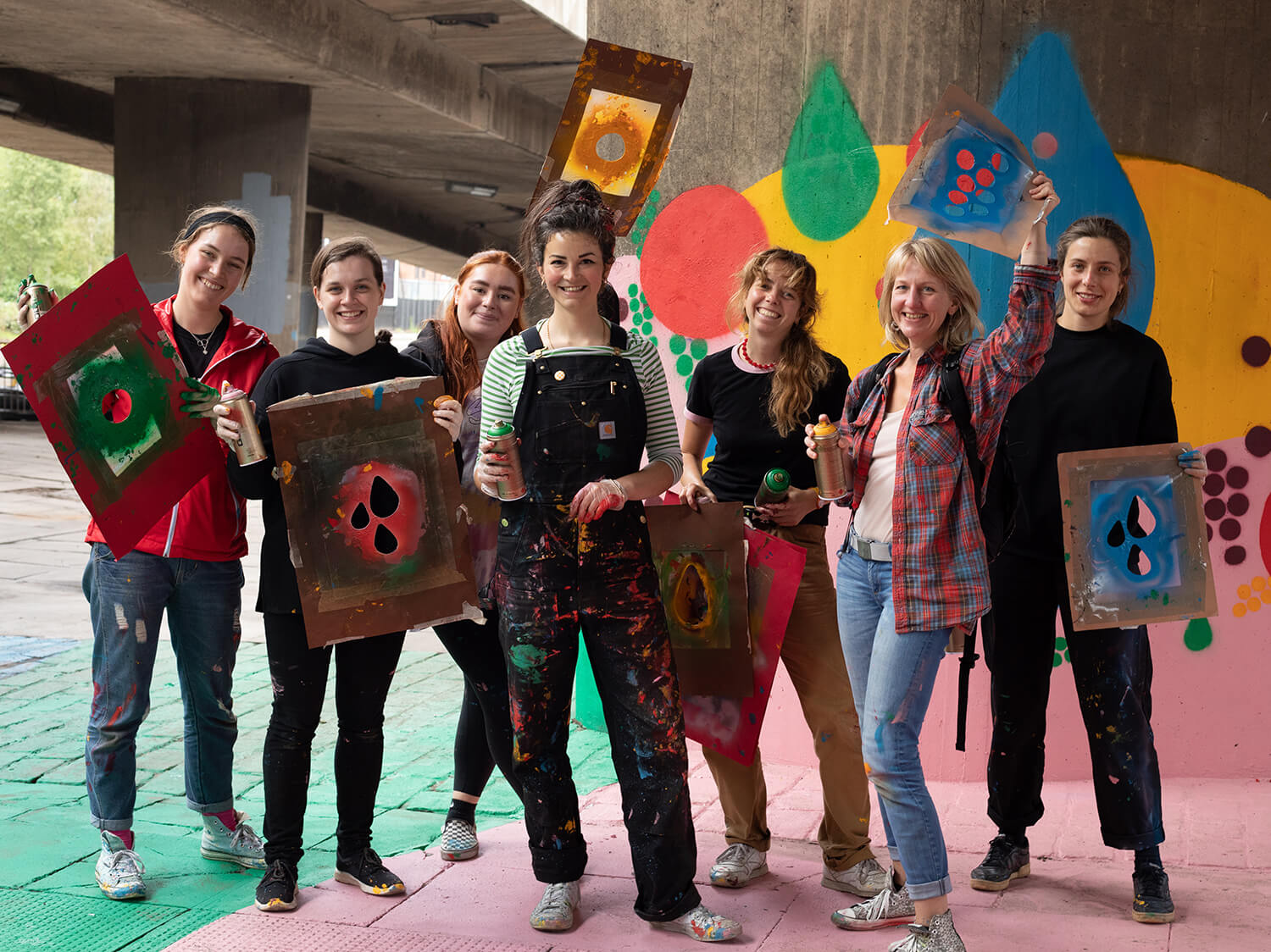
Specify whether the artist will only be producing a design or will also be managing the painting days. If the latter, note that asphalt art is different from traditional wall murals in several ways.
Using a street as a canvas means dealing with rugged surfaces, street closures, and related timing and safety considerations. If the artist is expected to manage execution, be sure to make that clear, look for relevant experience, and compensate them accordingly.
Sample artist contract
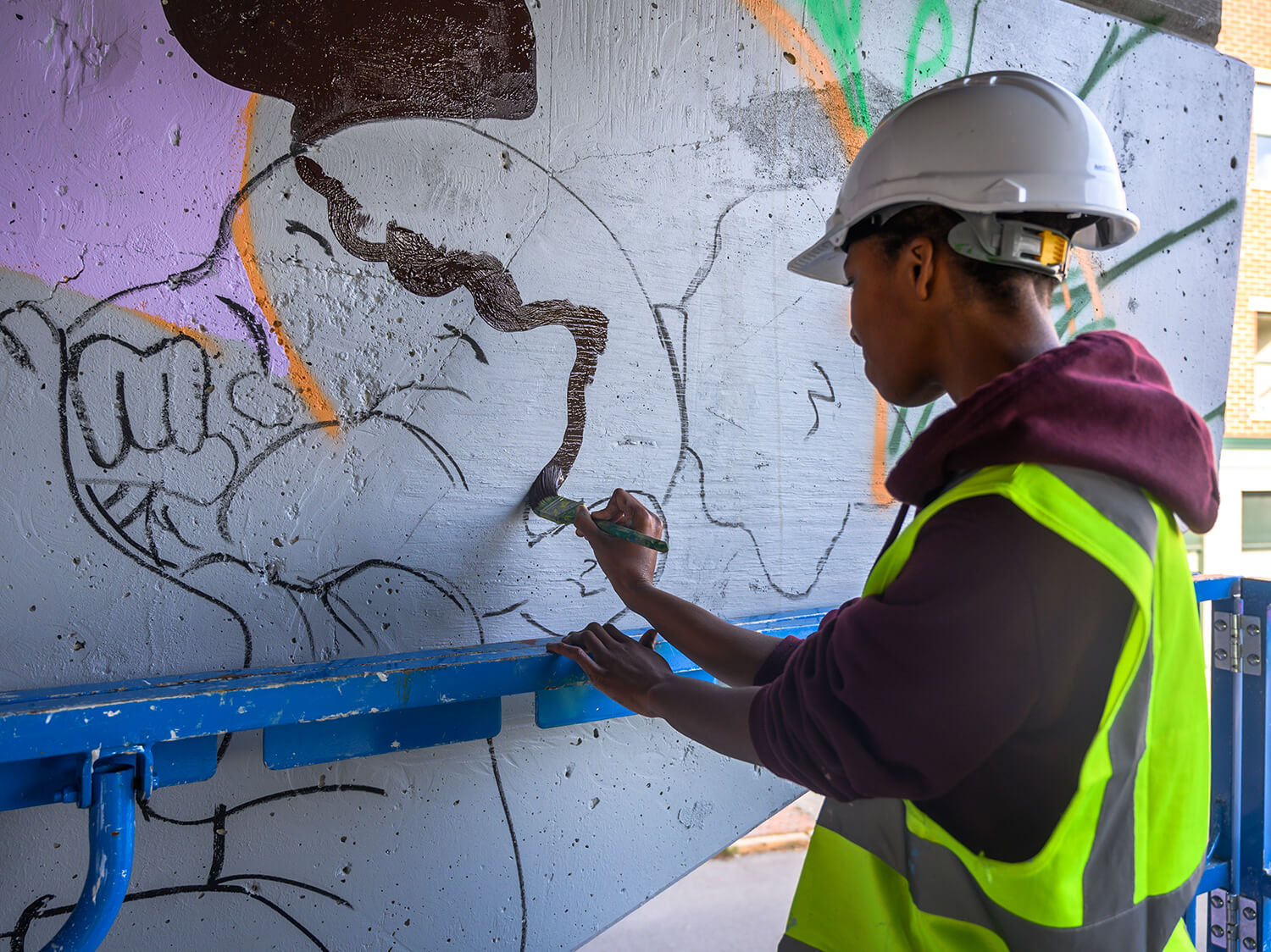
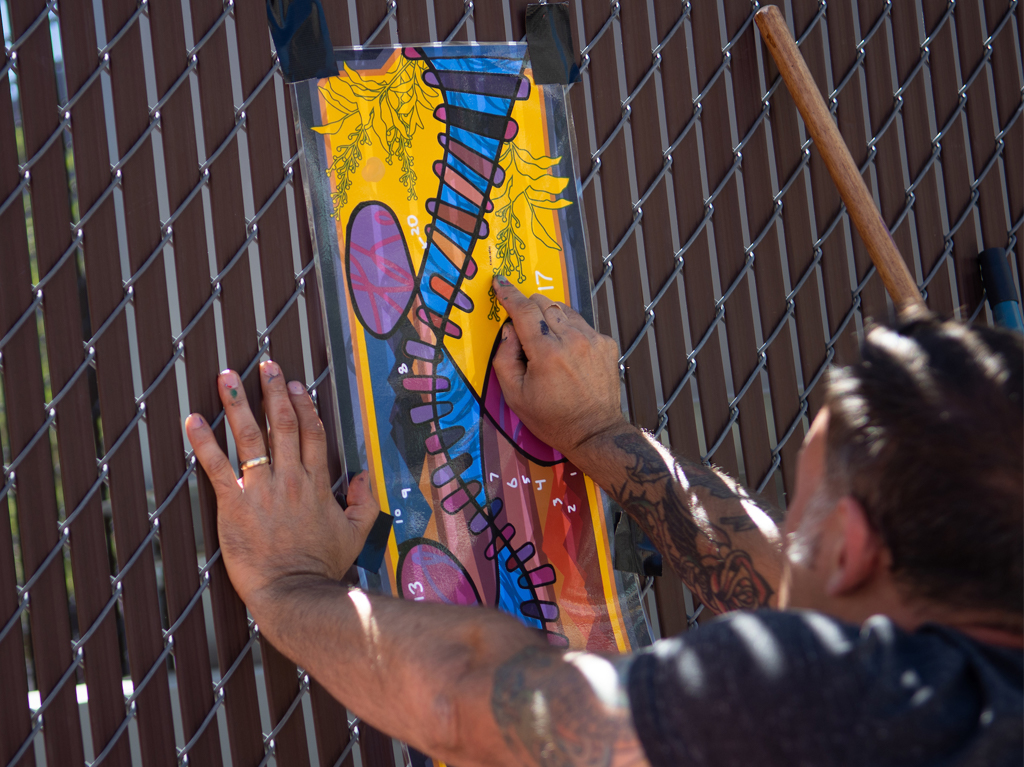
Doing an open call or otherwise soliciting multiple artists to develop concept designs can create an opportunity for community input in the selection process. A jury of stakeholders can be designated or a public vote can be taken. In going this route, it is best practice to provide a fee to finalist artists for their designs.
Sample flyer for public voting
Read more in the Asphalt Art Guide
See pages 82-83 for reference
How can I bring community members into the design process?
It is critical that community members are centered in the design process because they have first-hand knowledge of their streets and public spaces. The community can help at various stages of a project, including selecting sites where an intervention would be most impactful as well as providing input on the artistic design.
Remember that outreach methods that work in one neighborhood may not work in another. That said, the best initial form of outreach is usually in-person and on-site. Talking directly to people who live and work at the site can insure an approach that will work for the area. Leveraging the involvement of businesses, churches, and community groups can help organize the conversation and amplify the process.
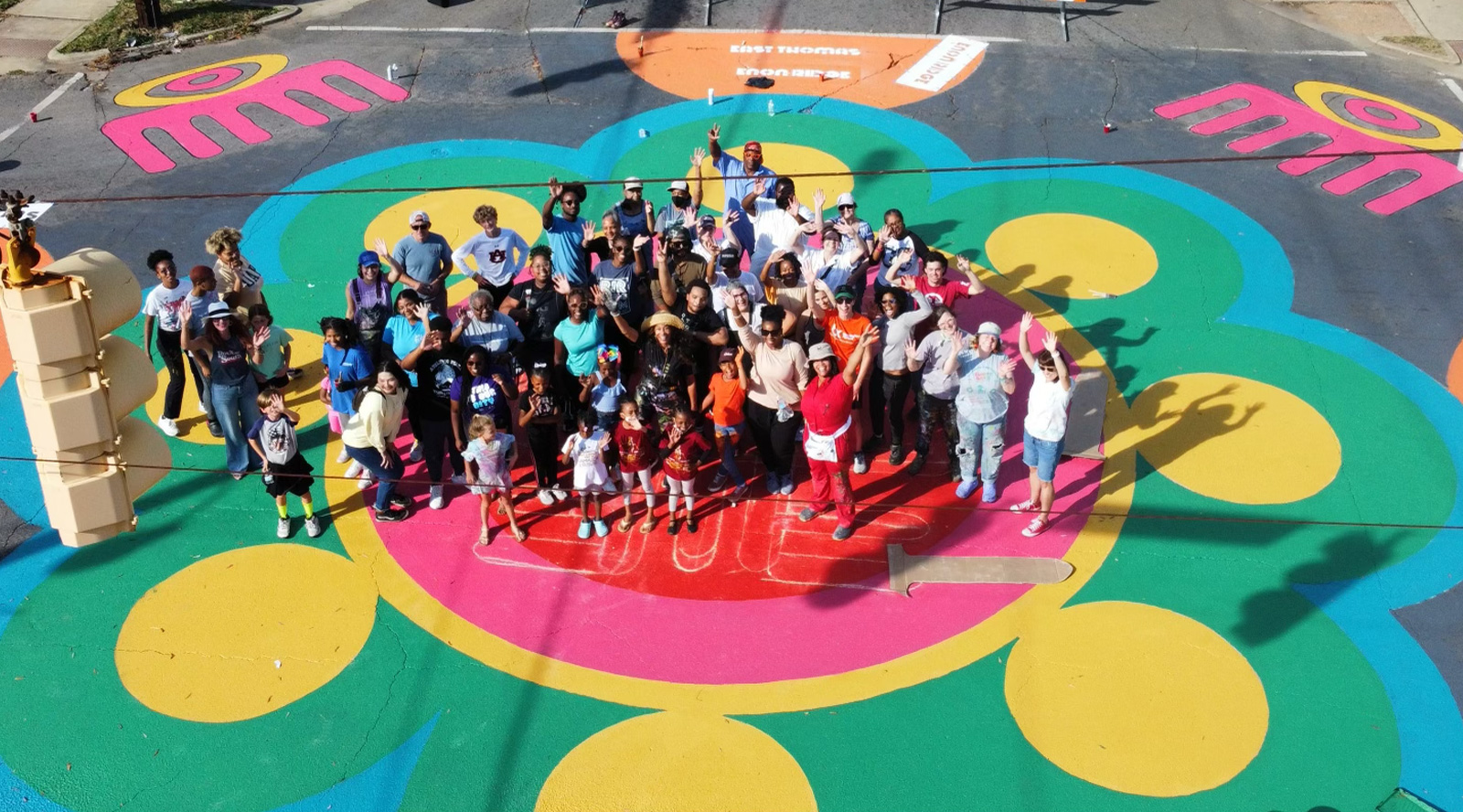
Here are a few ways to ensure authentic and collaborative public involvement:
Design Workshops
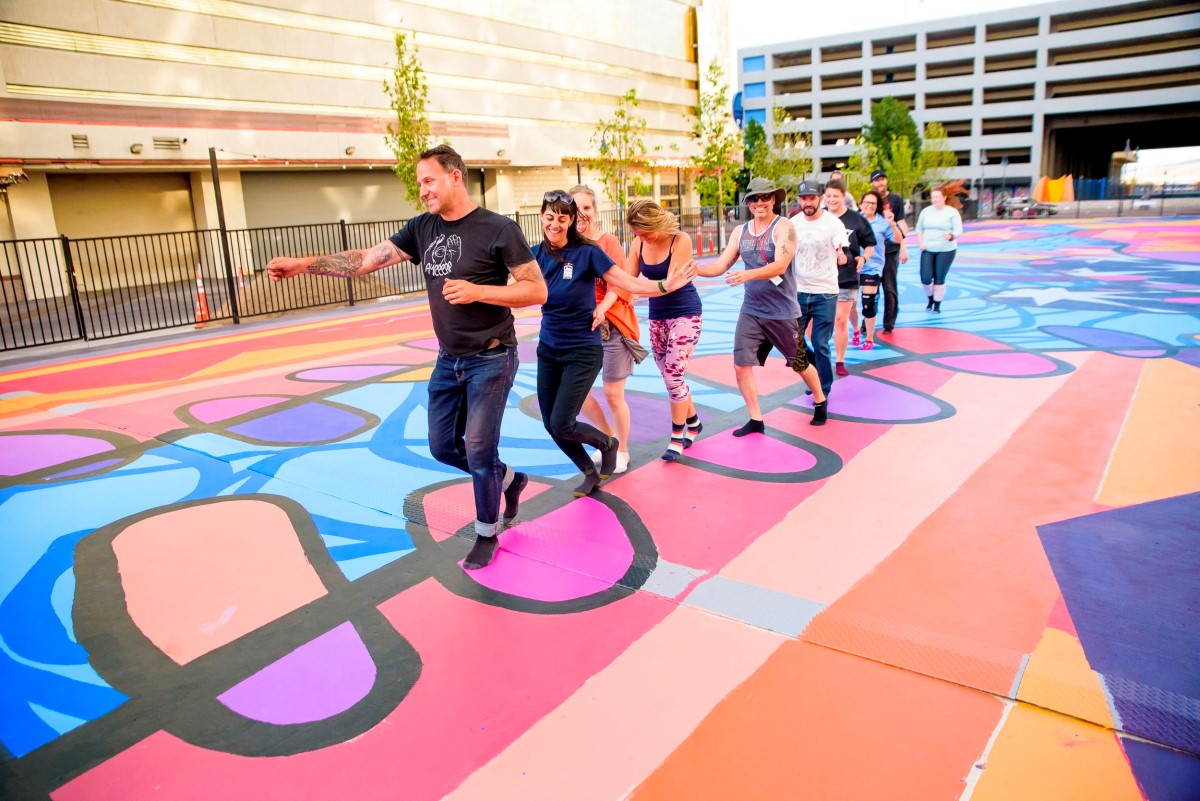
A good way to structure a community conversation around art and site design is by hosting a series of workshops that bring together local community groups (i.e., schools, neighborhood association groups, local businesses, bike coalitions) and city staff. Examples of workshop activities include asking folks to help identify the scope of the intervention (e.g., painting crosswalks vs. the center of the intersection), or identifying themes, styles, colors, or imagery for the artistic design. Participation strategies include inviting participants to draw ideas on a large scale site map, or even directly onto the street/sidewalk with chalk. If in-person workshops aren’t feasible, virtual options have proven to be valid and engaging.
Community Project Examples
See our Chattanooga and Pittsburgh projects for examples of community workshops.
Site Tours
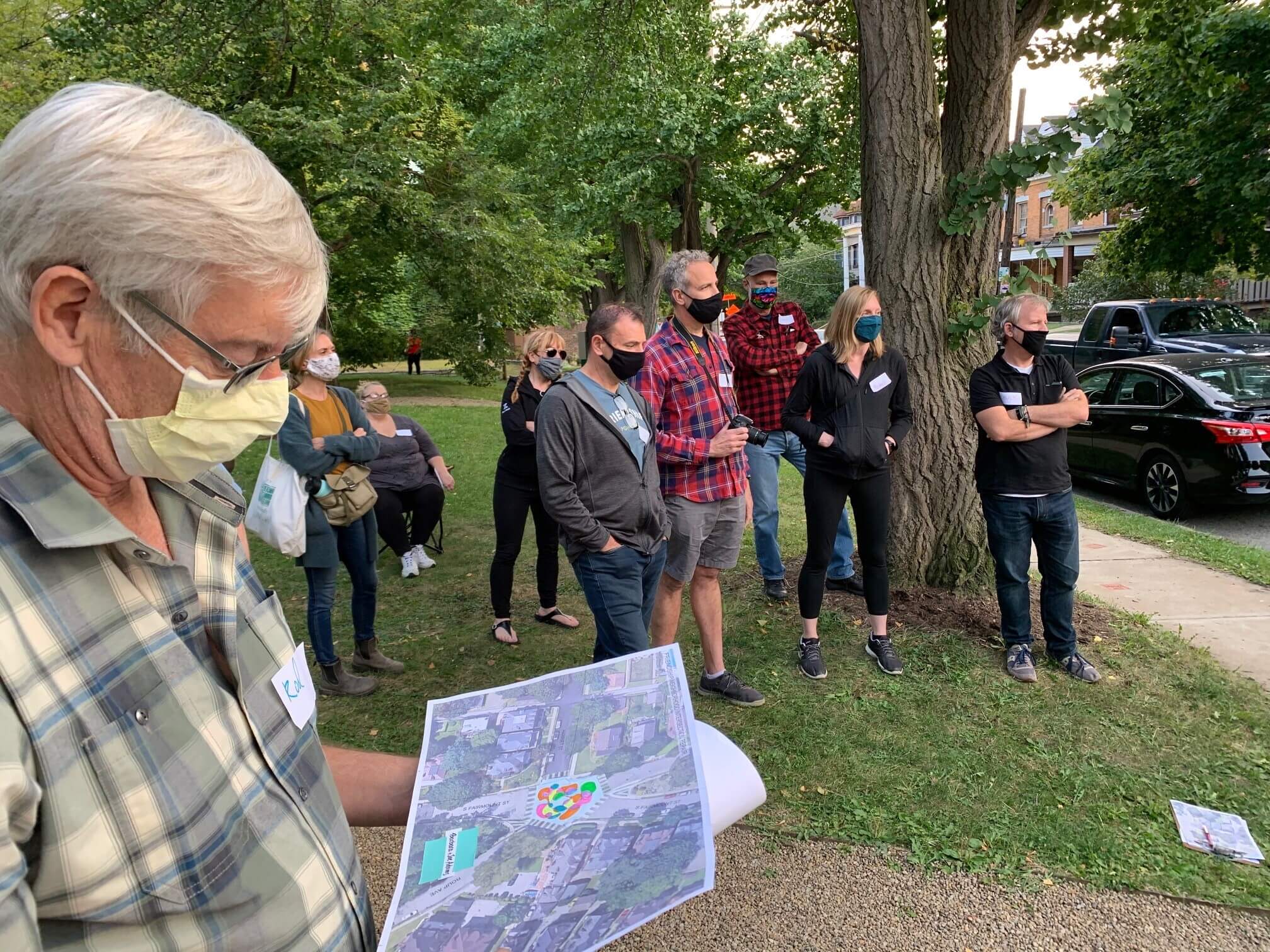
Conducting a walking audit or survey of the site(s) with city staff and the public can provide important mutual benefits. The public has the opportunity to offer insights about their daily interactions with the site, and the project team can identify site conditions that may be challenging.
Door to door
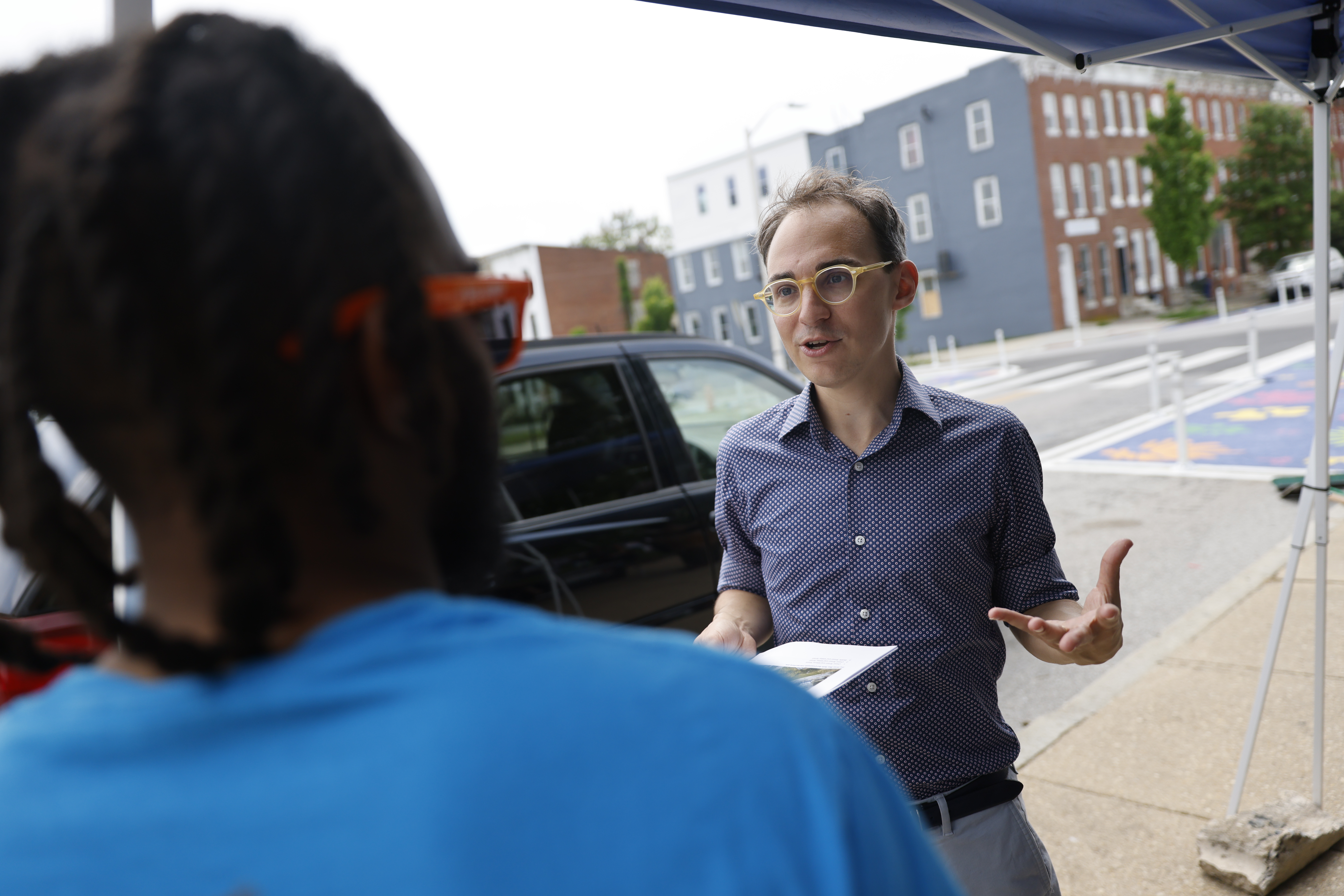
Door-to-door outreach is highly effective in informing and engaging folks in a project that is close to their home or business, and to source volunteers. If there is an existing, well-attended event or community meeting to join, that may be a good forum to share plans as well.
Surveys
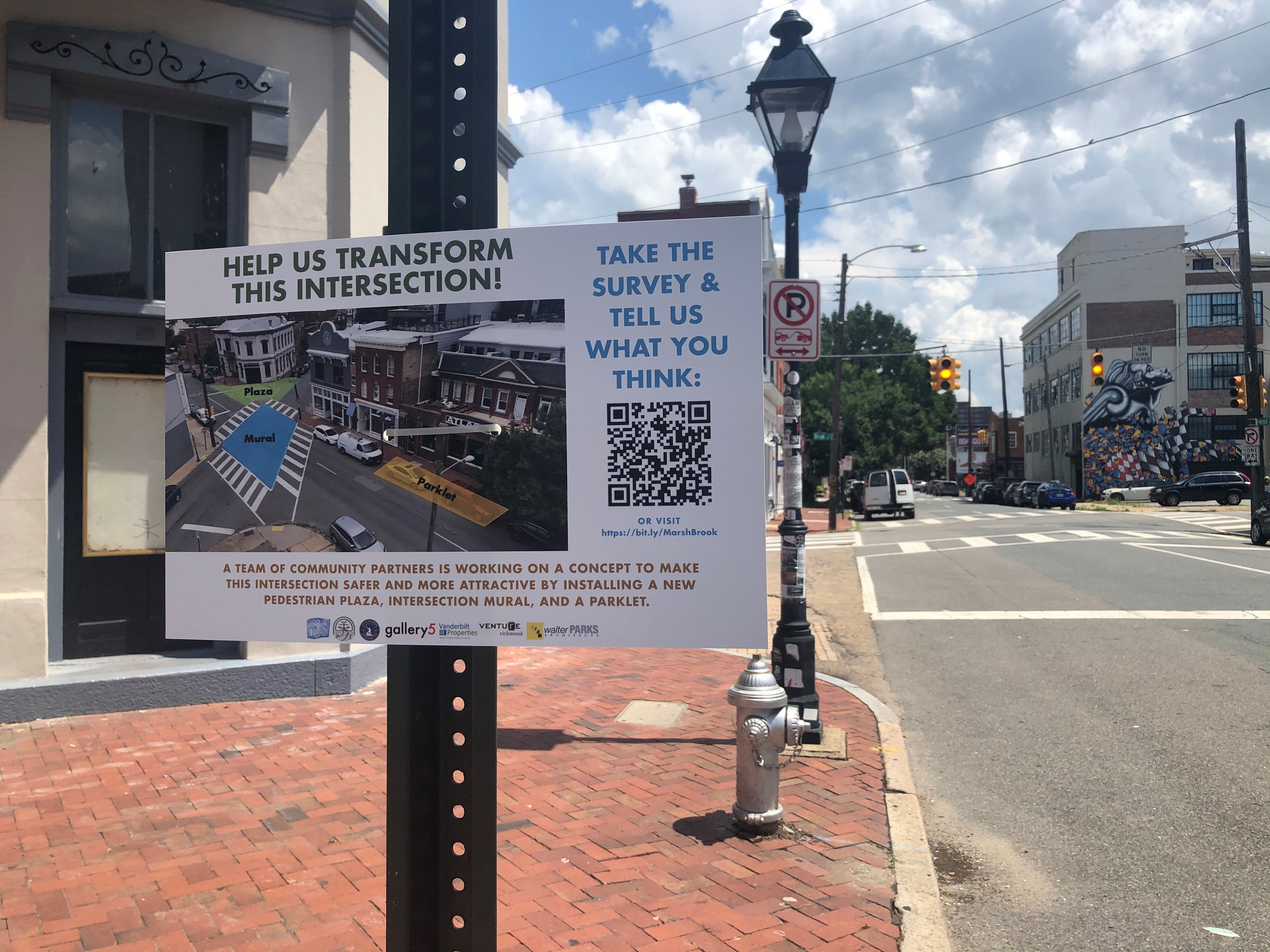
Online or in-person surveys are a great way to solicit community feedback. The surveys can be about site selection or about the design of the asphalt art itself. The survey can ask the public about their preferences or ideas with regard to color, style, cultural/historical icons, or other subjects they would like to see reflected in the art. They can also be a great way to get baseline information about usage and perception of the site.
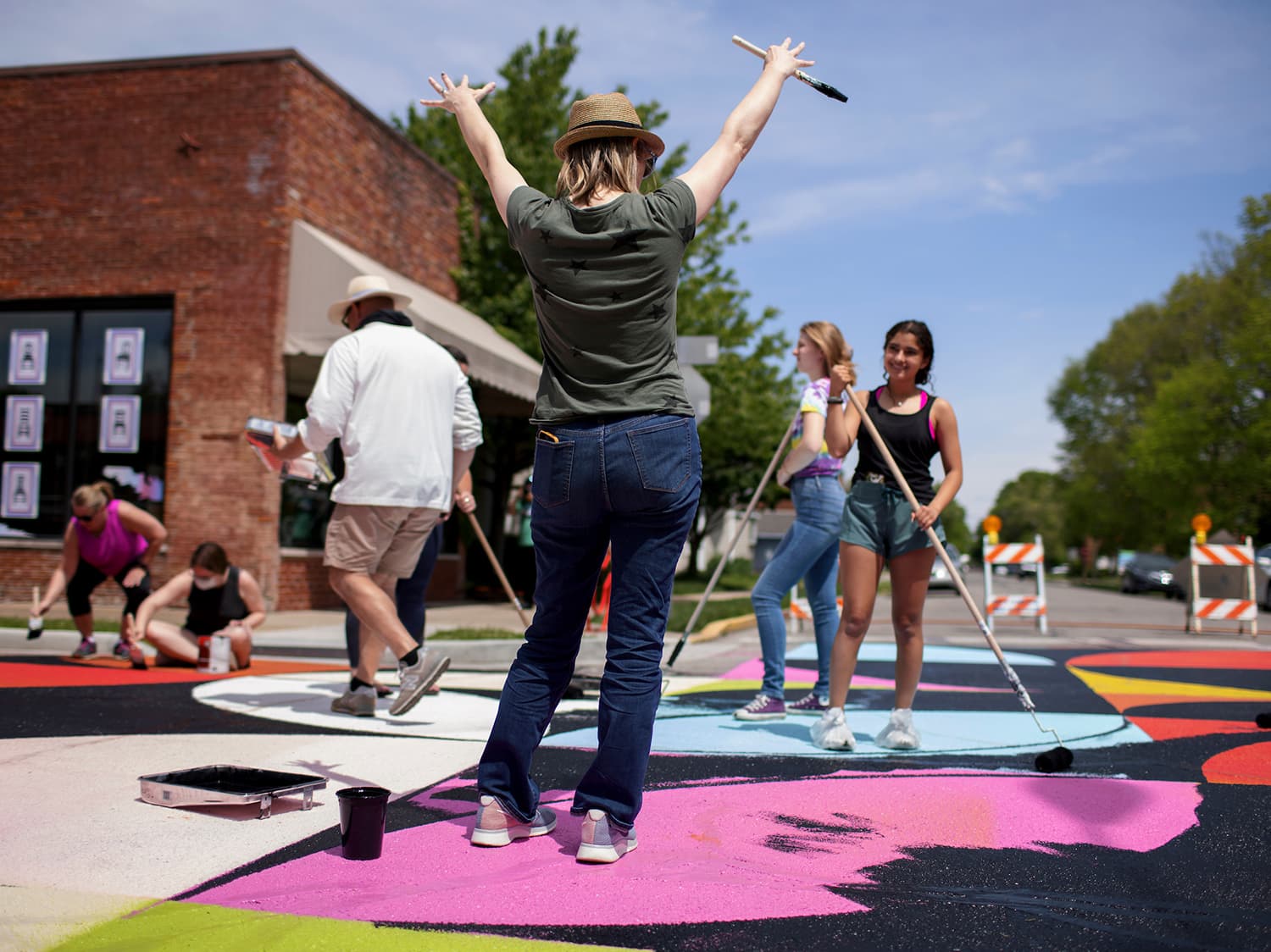
The painting day
The installation itself can be one of the best ways to generate community involvement if the project is structured to accommodate volunteer participation. In that case, it will be important to plan ahead around providing as water, bathrooms and food, as well as traffic safety for everyone working on the site. See the section on organizing a volunteer painting day for more information.
Read more in the Asphalt Art Guide
See pages 90-91 for reference
This content was produced by Bloomberg Associates in collaboration with urban planning and architecture firm Street Plans Collaborative.
Header image credit: City of Tucson Department of Transportation & Mobility
What type of paint should I use?
Choosing a type of paint depends on the desired duration of the project, expected level and type of traffic, and the maintenance capacity of the project team. Shorter term paints will wear faster, but likely cost much less. Discuss expectations with project partners early on in the process so that all are aware of the relationship between cost, durability, and anticipated wear.
When evaluating paint types, consider the level of traffic that will be experienced across the surface being painted. For crosswalks where there will be heavy traffic (over 20,000 ADT), thermoplastic or epoxy treatments will wear better than paint. For curb extensions that will not see a significant amount of traffic, paint may wear less fast, but will still collect debris and get dirty.
See sample photos of the longevity of different paint types here.
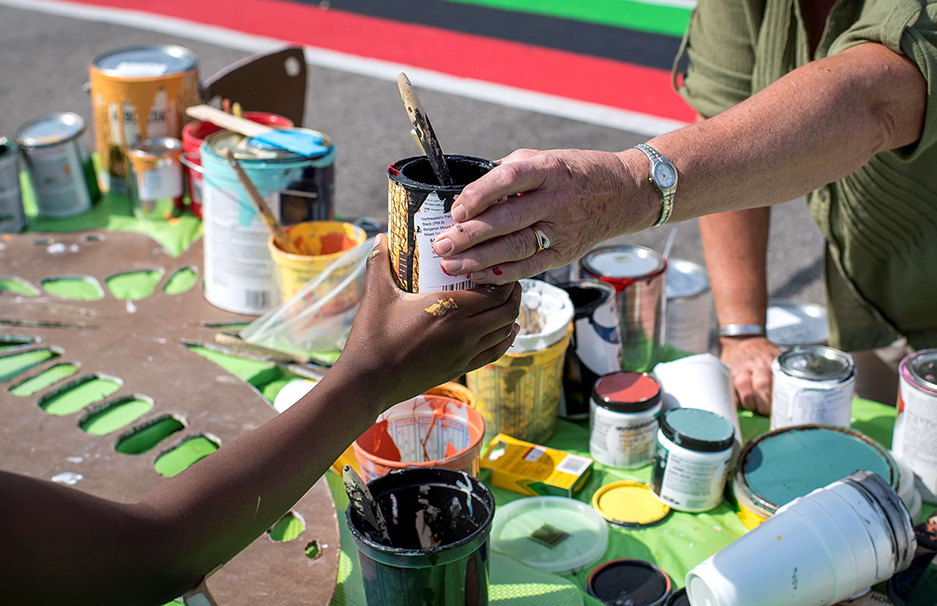
For short-term duration projects (1-7 days)
When sketching out design ideas on the site, or doing an otherwise hyper-temporary project, a washable paint such as tempera is ideal. This type of paint is easy for volunteers to apply and easy to remove. Tempera is also water-based and generally eco-friendly so that any runoff is harmless. These projects are a fun, low maintenance way of testing ideas without making significant investments in time, money, and political capital.
For mid-term duration projects (6 months – 2 years)
Teams can use acrylic or latex traffic paints, particularly for curb extensions, crosswalks or intersection murals. The cost is relatively low, volunteers can be involved in the painting process, and these paints come in a wide variety of colors. Note that these materials are generally found as exterior water- or oil-based paints; water-based paints tend to be easier to remove than oil, but also are at greater risk of peeling prematurely. With either type of paint, keep in mind that the longer they are on the ground, the more they will wear and get dirty. While asphalt art projects are often intended to be temporary, be prepared to touch up or repaint after a year or so if you want to maintain the design (or introduce a new one). For specific paint brands, consult a local paint supplier or the State Department of Transportation approved materials list for traffic paint suggestions. Common brands used for asphalt art include Sherwin Williams Latitude, Sherwin Williams Armorseal, H&C Heavy Shield, Hotline traffic marking paint and StreetBond coatings.
For long-term duration projects (3+ year)
The recommended material would be an epoxy-based concrete or pavement coating, or a thermoplastic. Thermoplastic will be the most durable, and is recommended on roads with volumes greater than 15,000 or 20,000 vehicles per day, but it is also the most expensive type of application. Note also that thermoplastic and epoxy can be limited in their color selection, and volunteers cannot be involved in the painting process. Common brands include Ruby Glass and Ennis Flint.
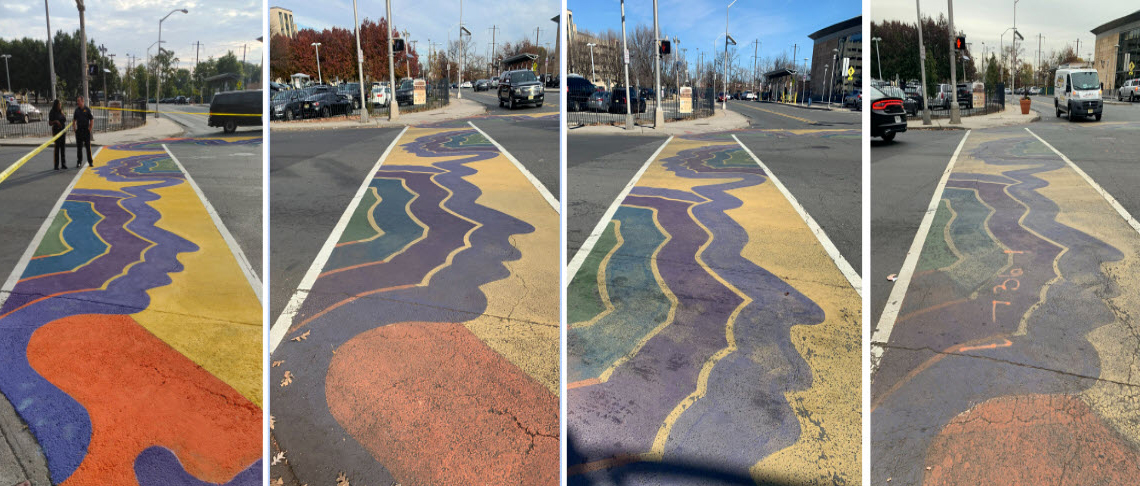
Additional issues:
Surface
When choosing paint types consider the type of substrate (concrete vs. asphalt) and consult with a local paint company to choose a paint accordingly. Also consider factors such as the condition of the pavement (new vs. old), as well as past debris or oil stains.
Friction Additive
Some paints may require an additive such as “Shark Grip” to increase adhesion to pavement and make the painted surface less slippery when wet.
Amount of Paint
Talk to a local paint company to assist with estimating the amount of paint to order.
Primer and Sealant
For increased longevity, consider using a binding agent or primer before painting, or a sealant after the artwork is completed. Asphalt art teams have used H&C ClariShield Clear Concrete Sealer, but consult your a local paint company for brands that will work with the selected paint.
Application Method
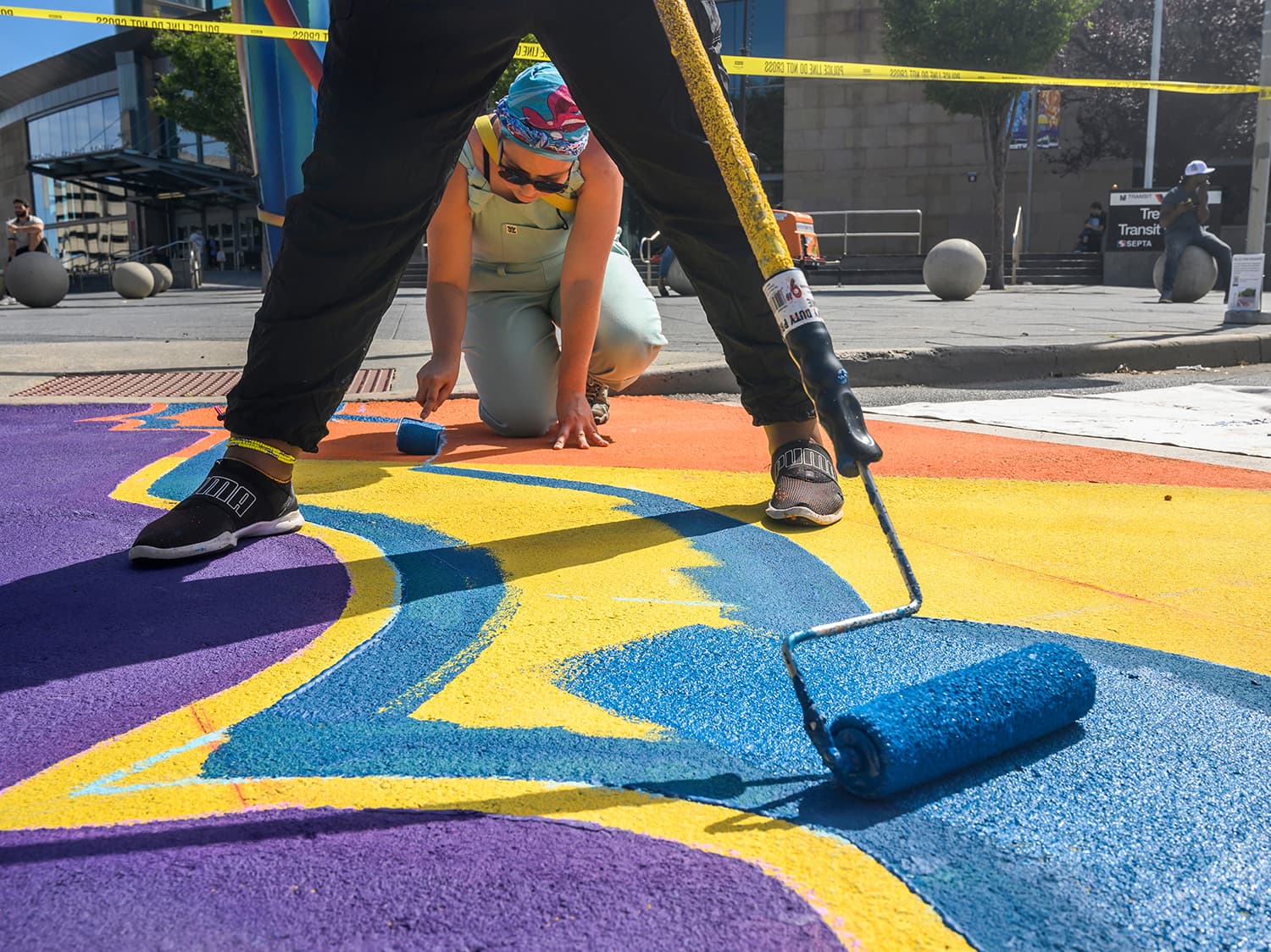
Most projects involving volunteers use rollers to apply large swaths of color and brushes (or small rollers) for detail work. Pouring paint directly onto the asphalt and using a roller to spread it out can cover ground quickly but may use up more paint. Using a paint sprayer can also be speedy, but may require a professional to operate.
Vertical Protection
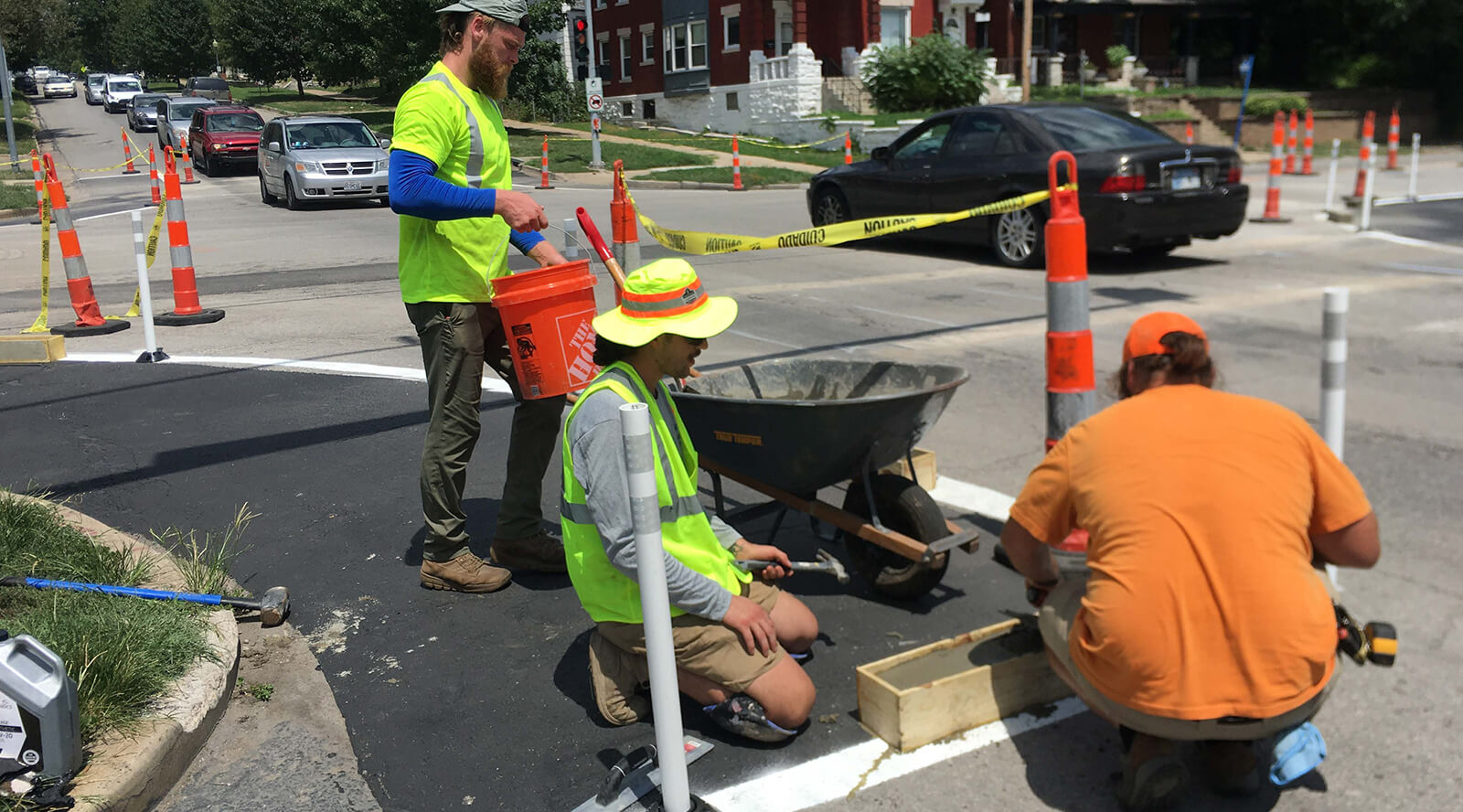
Review this guide for recommendations on the many options for vertical roadway design elements to protect your project once it’s installed.
Read more in the Asphalt Art Guide
See pages 88-89 for reference
How do I account for the impacts of resurfaced asphalt?
For sites that have been recently resurfaced with new asphalt, here are a few guidelines:
- If using paint, the best practice is to wait up to 1 year from the time of resurfacing to allow the asphalt to properly cure. This will ensure that the asphalt has cured sufficiently, and allow the paint to bond properly to it.
- In cases where fresh asphalt has been applied to potholes or pavement cracks, short of a full resurfacing, allow at least 1 or 2 months for it to cure. Fresh asphalt is likely to be more oily and porous, typically requiring more paint to be applied than weathered asphalt.
- If using thermoplastic, it can be applied as soon as the fresh asphalt has cooled, if necessary due to scheduling. If possible, wait 1-3 months of curing time before applying.
In all cases of recently paved surfaces, consult with a local paving contractor. The local trades will have the best knowledge of how fast asphalt cures in each region based on weather and other conditions.

How should I prepare my site for painting?
To ensure a proper curing process for asphalt art projects, sites should be cleaned prior to installation:
Debris
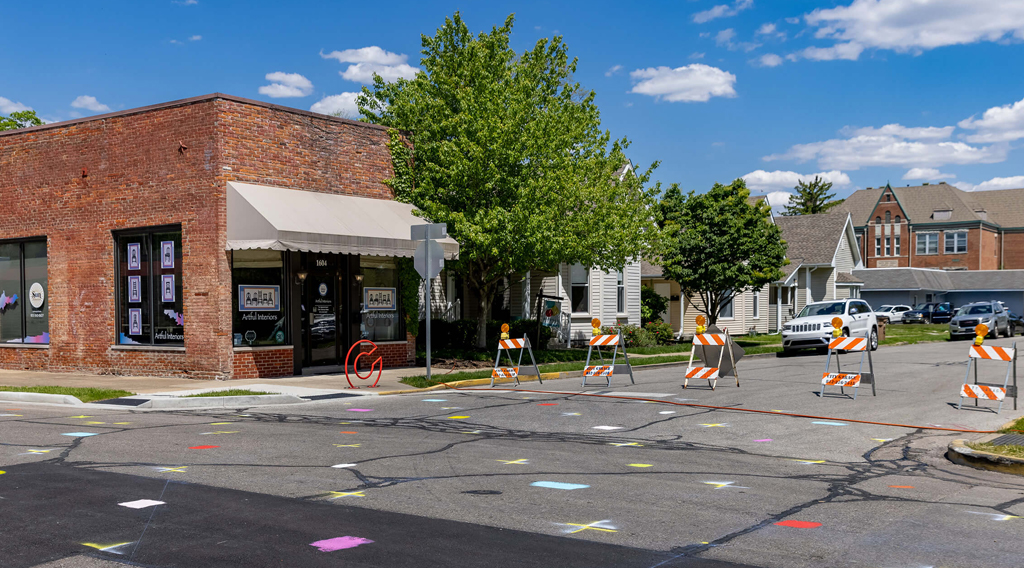
The site should be clear from oil, dirt, rocks, grass, and garbage. The dirtiest part of a street tends to be the gutter pan, so it needs special attention. If there are street trees, be mindful of leaves, dried fruits, and animal droppings. It is common practice to have a leaf blower on hand during installation to ensure that the painting area remains clear of debris.
Dirt
If a site is particularly dirty, consider power washing or using a street sweeper. If power washing is not an option, try using regular soap and water and a hard bristle broom to remove any heavy debris. When washing the street, also be sure to schedule ample time for the pavement to dry prior to painting.
Cracks and Potholes
Cracks or small holes should be patched or filled before painting, but note that paint may adhere to the patched areas differently than the rest of the asphalt. If the asphalt is in poor condition overall, consider repaving sections of the street if an alternative location cannot be selected. For curing time recommendations, see the section above on resurfacing.
Moisture
The asphalt should be fully dry before applying paint. Even pavement that looks dry to the touch may have subsurface water that can lead to paint peeling or chipping, so be sure to leave adequate time after rainfall before painting. Also, be mindful of areas of the street that tend to be frequently wet, either because they receive runoff from irrigation or because they are lower in topography and water ponds regularly. These areas should be avoided as the asphalt or concrete is likely saturated with water and will be difficult to keep dry during painting; post-painting, designs may degrade quickly due to subsurface moisture.
Read more in the Asphalt Art Guide
See pages 88-89 for reference
How do I translate my design from paper to pavement?
Getting from a design on paper to art on pavement is one of the most challenging parts of doing an asphalt art project. The chosen artist may not have experience designing for large-scale pavement installations, in which case they may need assistance with the logistics. Here are a few pointers for how to adapt a design:
Timing
Consider the amount of time needed for laying out and executing the project, keeping in mind any time limits on closing affected streets and roadways. It may be necessary to simplify parts of a design without losing its essence, if logistics won’t allow for rendering the full idea.
Sequence
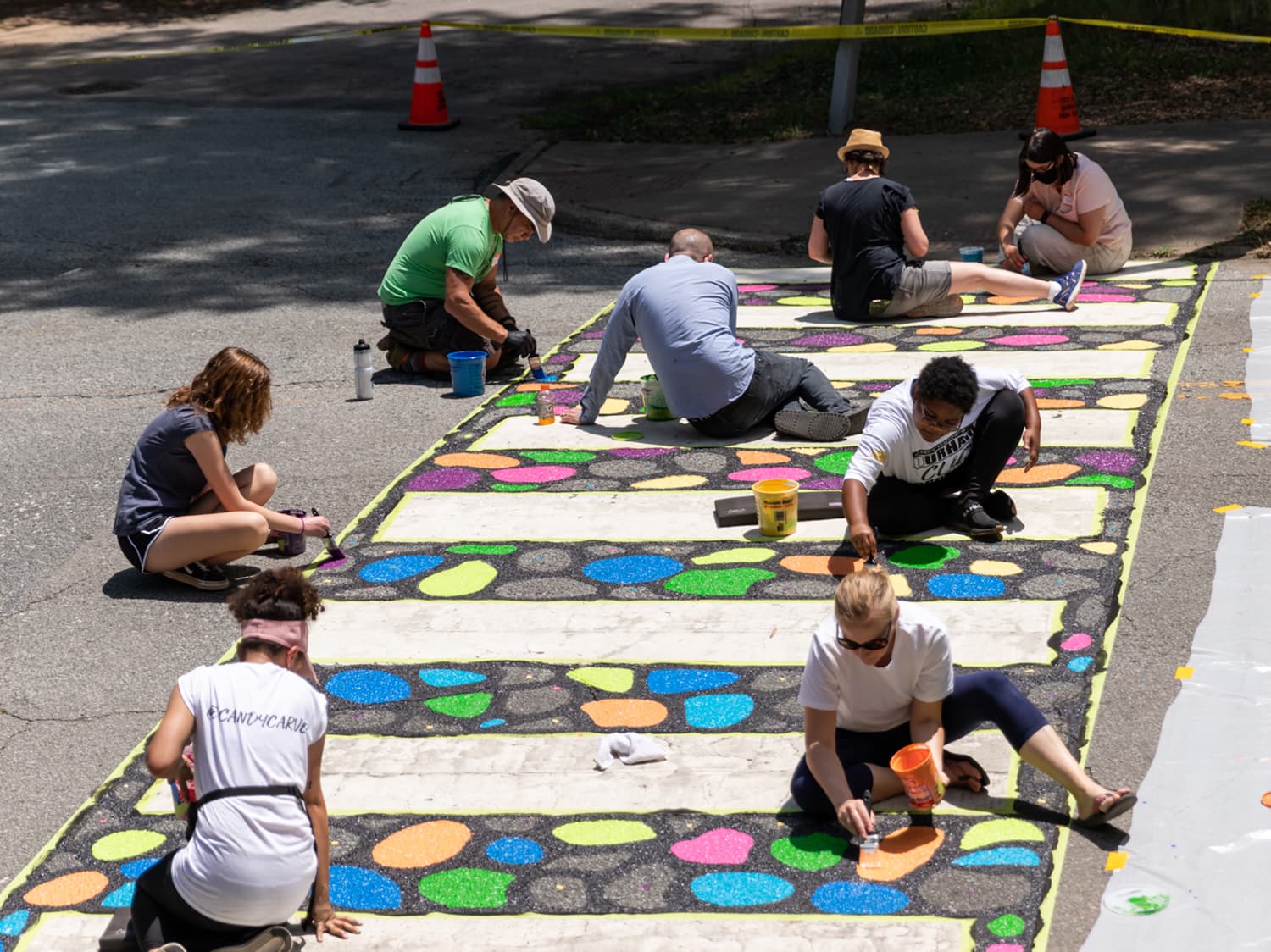
Think about the sequence of work. Is a base coat needed? How should large shapes be blocked out? Does the artist need to draw all shape outlines by hand, or is it possible to use stencils for repeated shapes to decentralize the workflow?
Dimensions
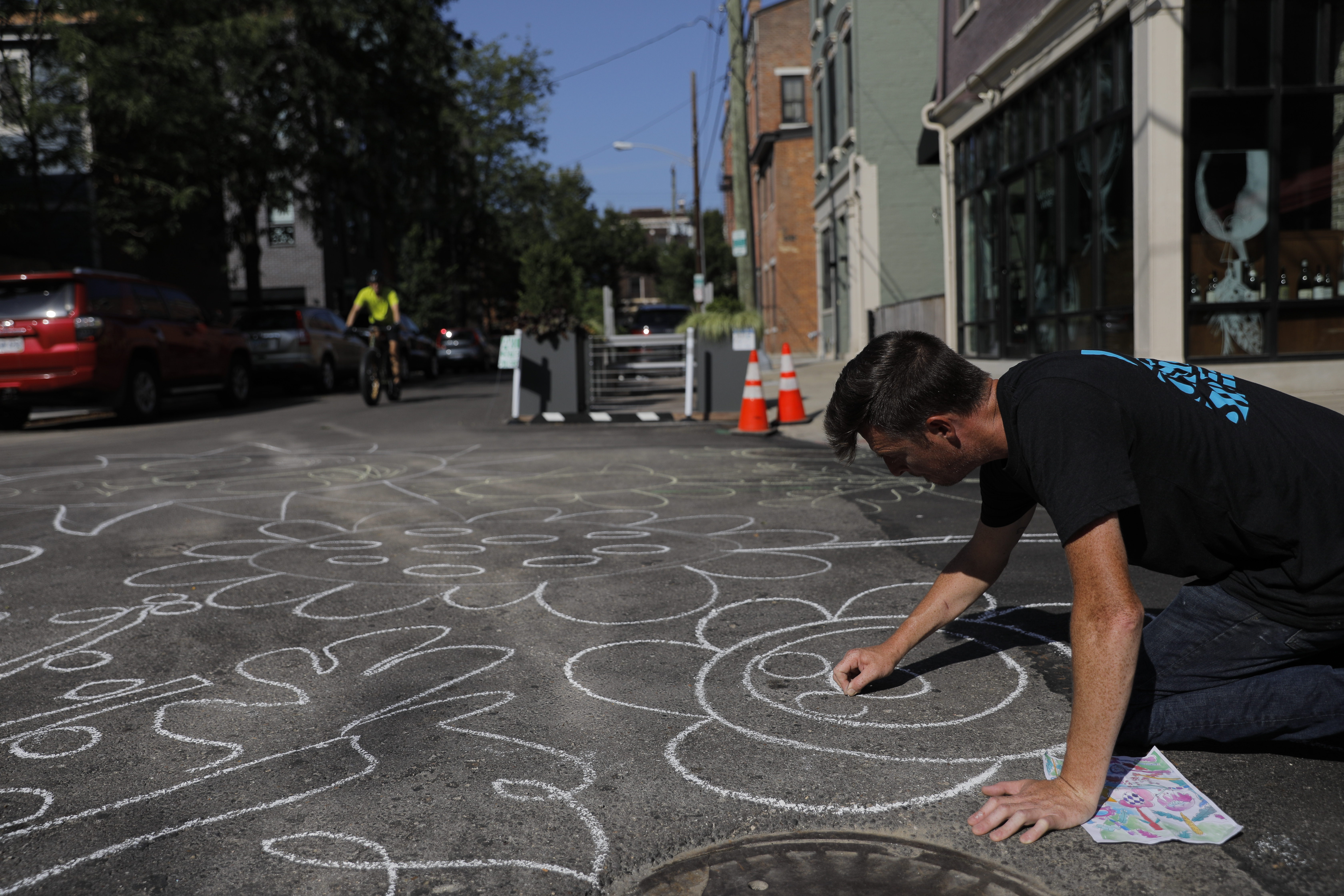
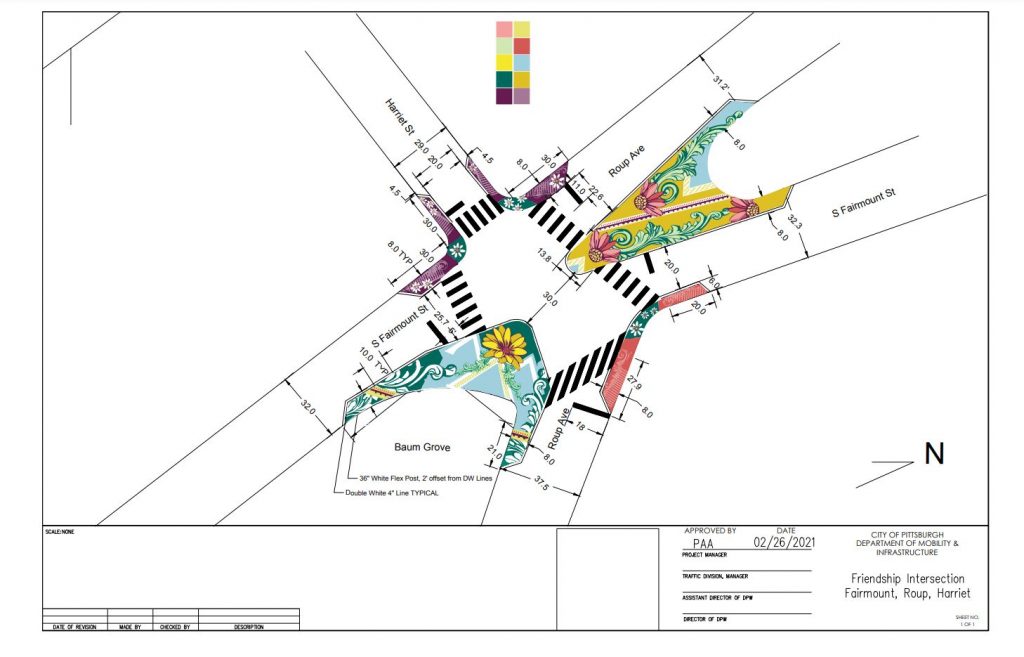
Prepare a detailed technical drawing, including dimensions, that shows how the design is placed into the context of the street space.
Outlines & Edges
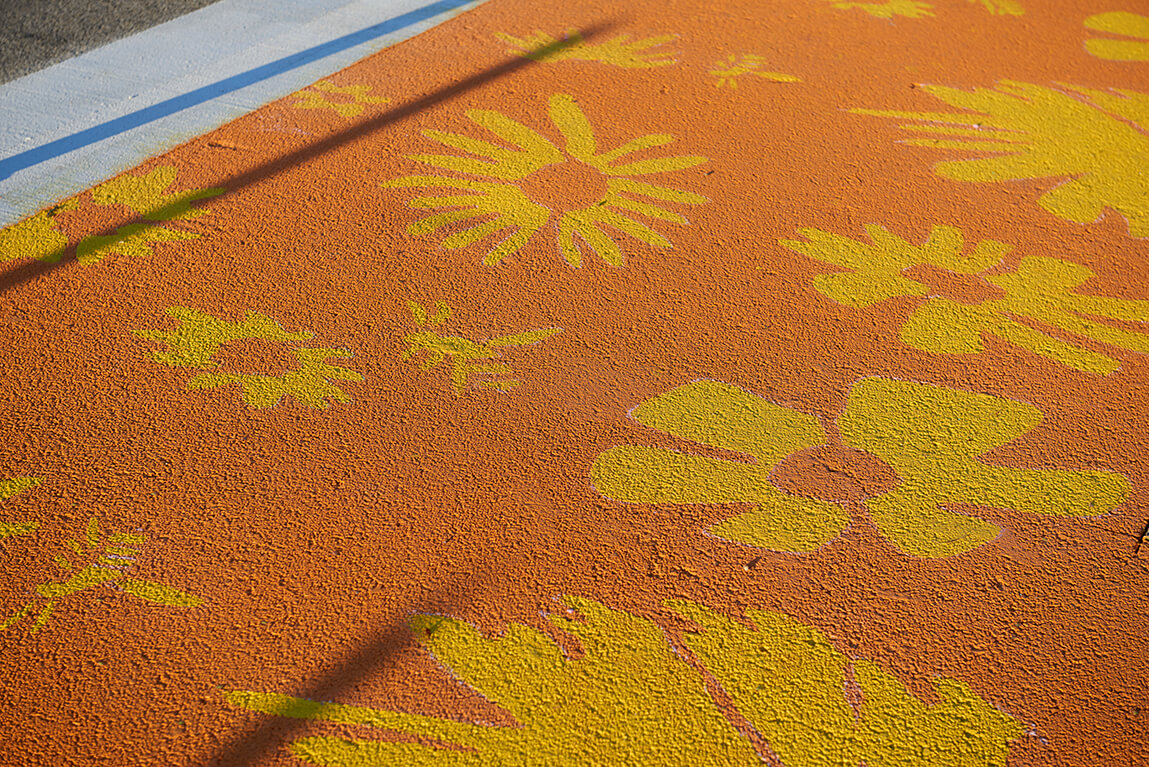
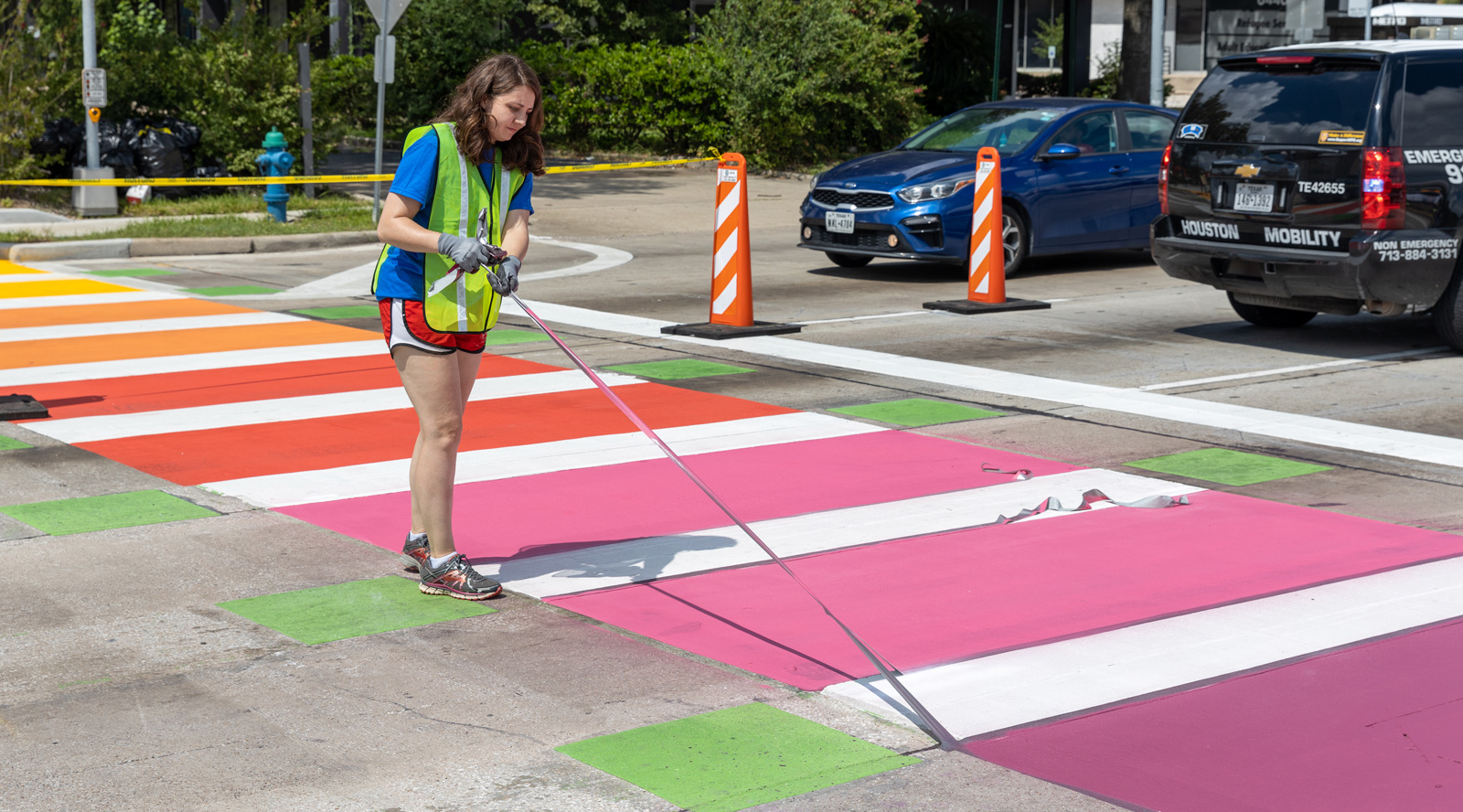
If the design includes organic shapes or irregular patterns, many artists outline shapes by hand using chalk or spray paint. To achieve straight edges for painted areas, Gorilla Tape can be a useful tool.
Grid
For large murals with an abundance of organic or representational shapes, consider using a grid that corresponds to the design plans. If laying out a precise grid is too time intensive, other methods of scaling and measuring include laying out a series of straight-line benchmarks, or anchoring the design with key dimensions.
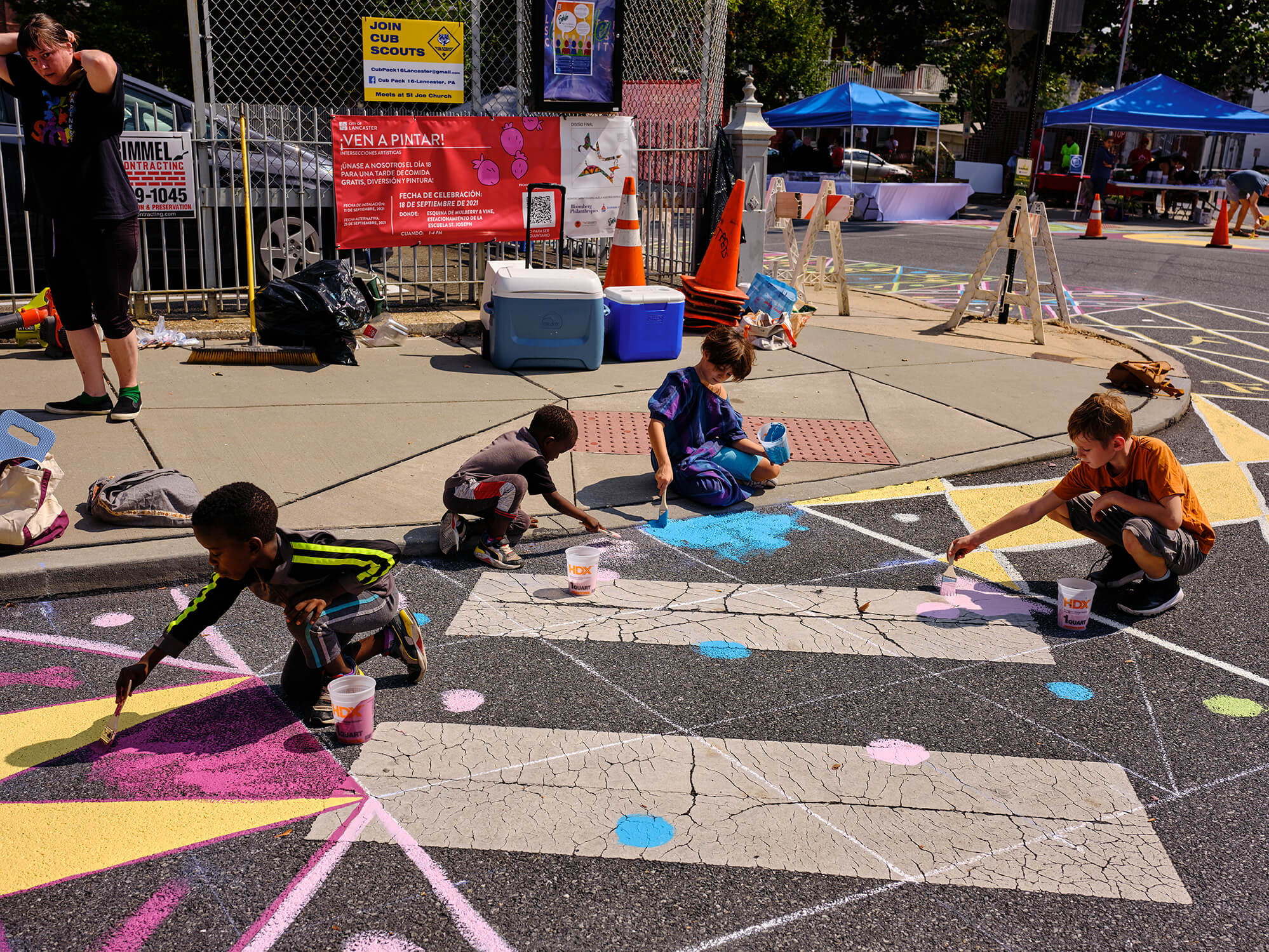
Stencils
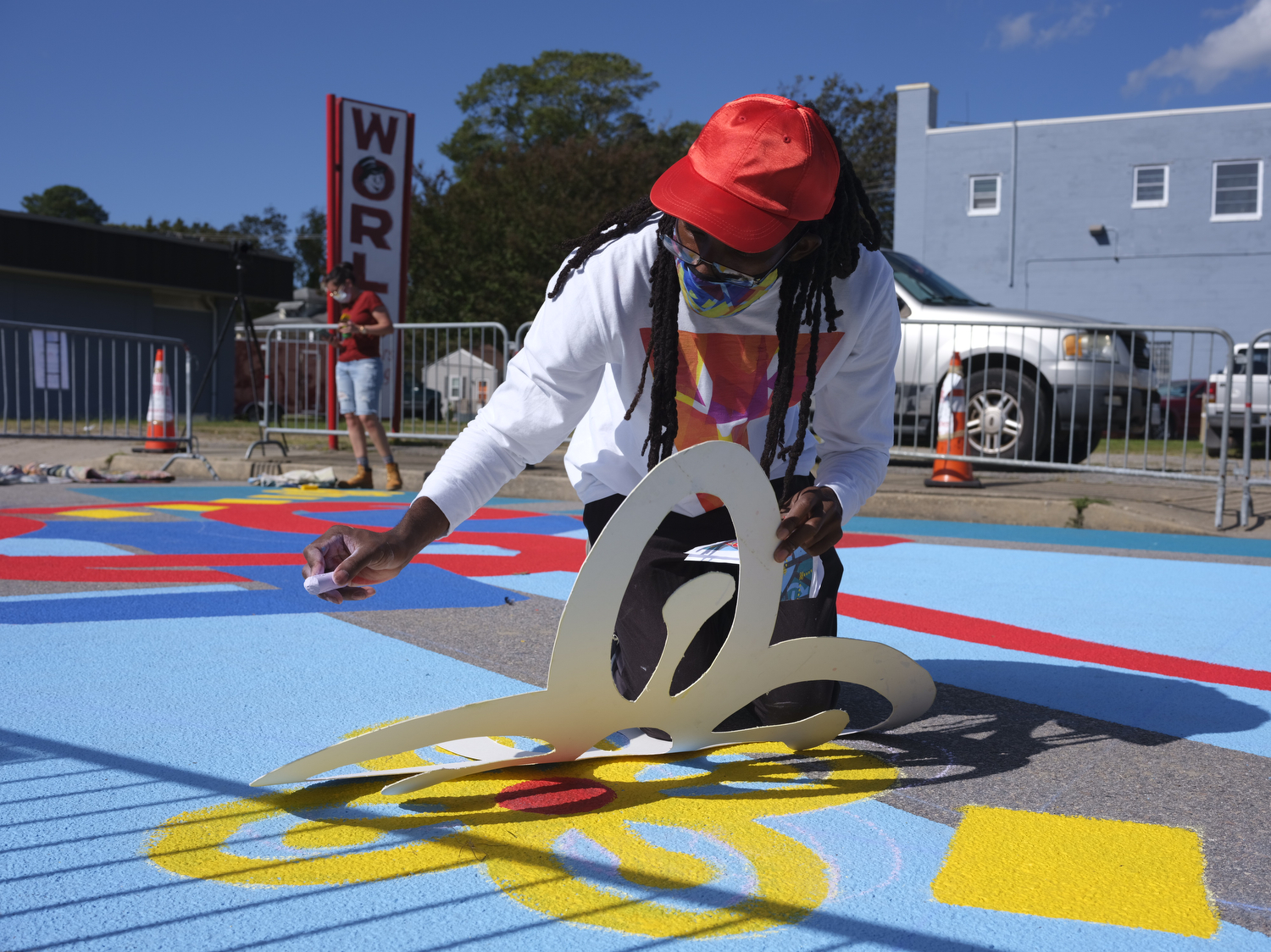
Stencils are useful for creating repeated shapes in a pattern. They can speed up the painting process and be a great way to involve community volunteers. Basic shapes can be hand-cut out of cardboard, and more detailed shapes may require laser-cutting. Consult a local fabricator for appropriate materials and costs.
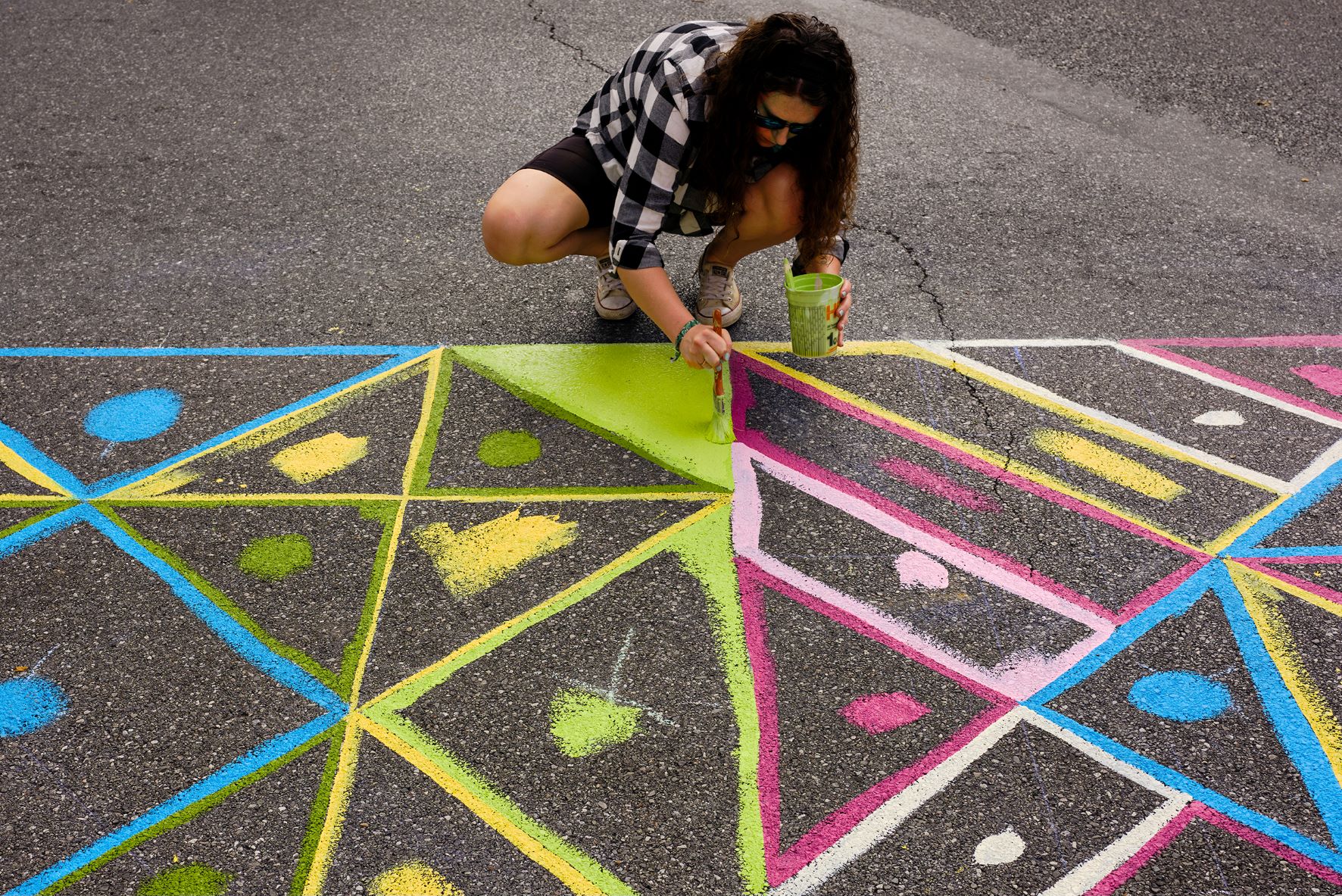
Paint By Numbers
When working with volunteers, the “paint by numbers” approach works well, though several members of the project team may be needed to supervise the process.
How do I organize a volunteer painting day?
One of the most common (and fun!) elements of paint-based asphalt art projects is the community painting day. Here are some essential components to ensure success:
Schedule
Once a design has been developed, think through the hour-by-hour schedule and order of operations for how the mural will get done. Consider the following when planning the timeline:
- Is it necessary to close the street? If so, how long will traffic controls be in place? This is often the biggest factor in timing.
- How will the design be blocked out and how long will that take?
- How many people will be needed to complete the mural within the allotted time frame? See a sample implementation plan here.
Volunteer Management
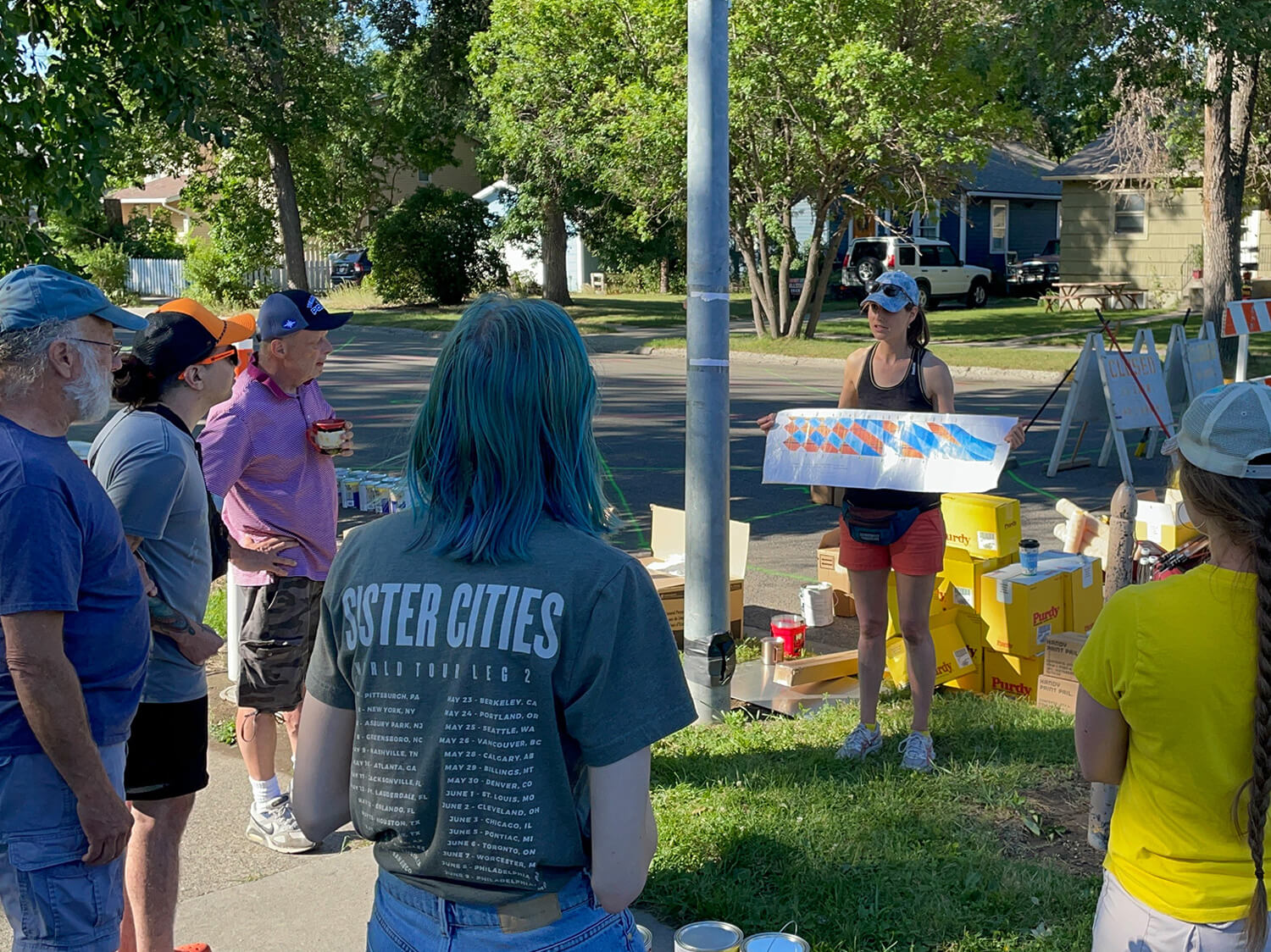
Assign experienced and trusted ‘captains’ to help distribute production and oversee volunteers. Understand that community members will need instructions on what to do, and may have frequent questions along the way. Set up a ‘host’ tent where volunteers can check-in, sign-waivers, get safety vests, and be directed to their work stations (and come back to get water and snacks!).
See our Troy project for an example of hiring project captains.
Outreach
After selecting dates to lay down the asphalt art, create an event invite for a “painting day” and post the information on flyers or postcards to be handed out. Also reach out to local community groups that can help spread the word about the event, and set up a user-friendly webpage where volunteers can sign-up for specific activities or timeslots.
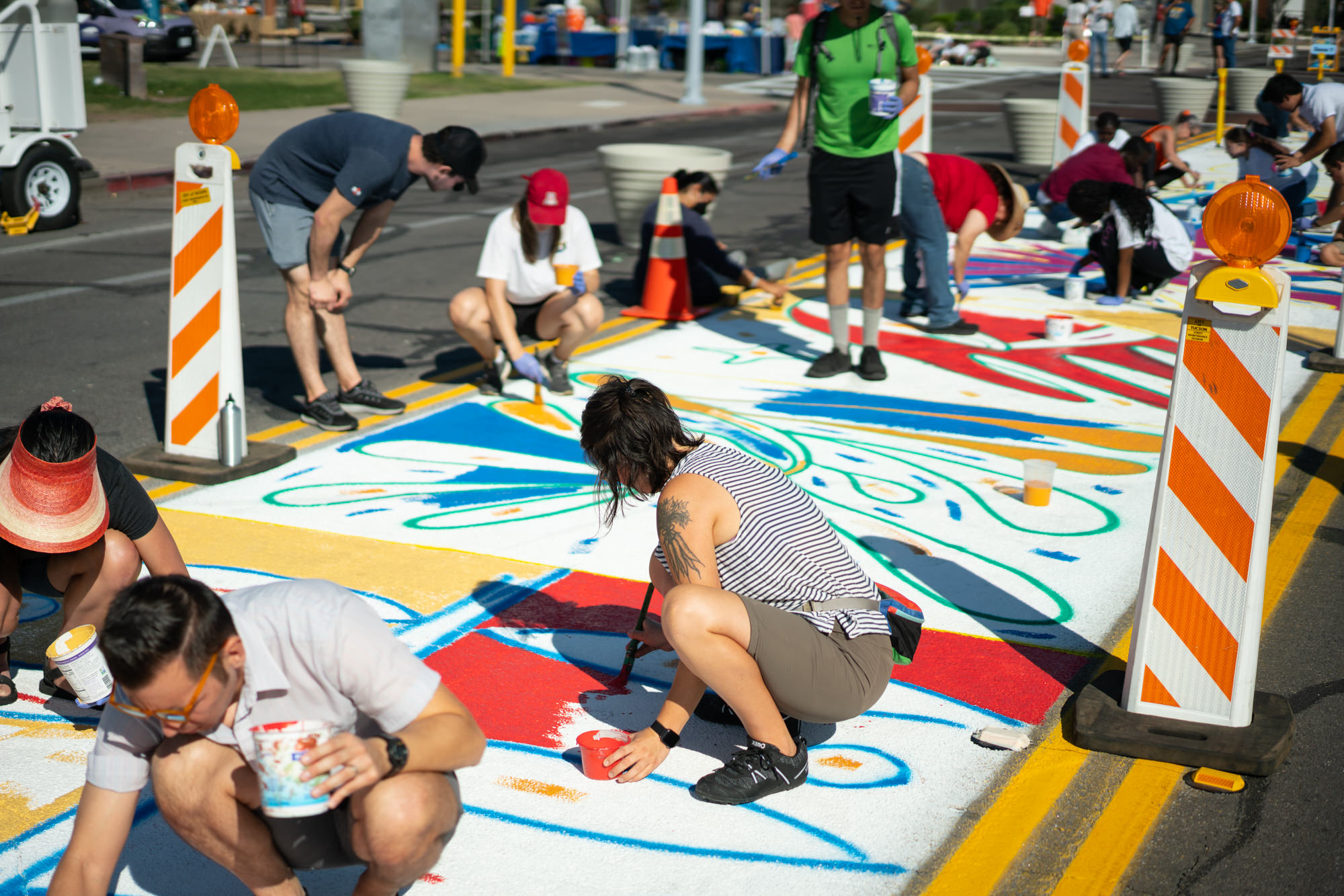
Design adjustments
After doing a first draft of a schedule and timeline, return to the design and consider whether there are enough resources to accomplish the work. If not, is there a way to adjust the design so that it is easier to complete? The best asphalt art designs often balance beauty and practicality.
See our Trenton project for an example of adapting a design to meet timing concerns.
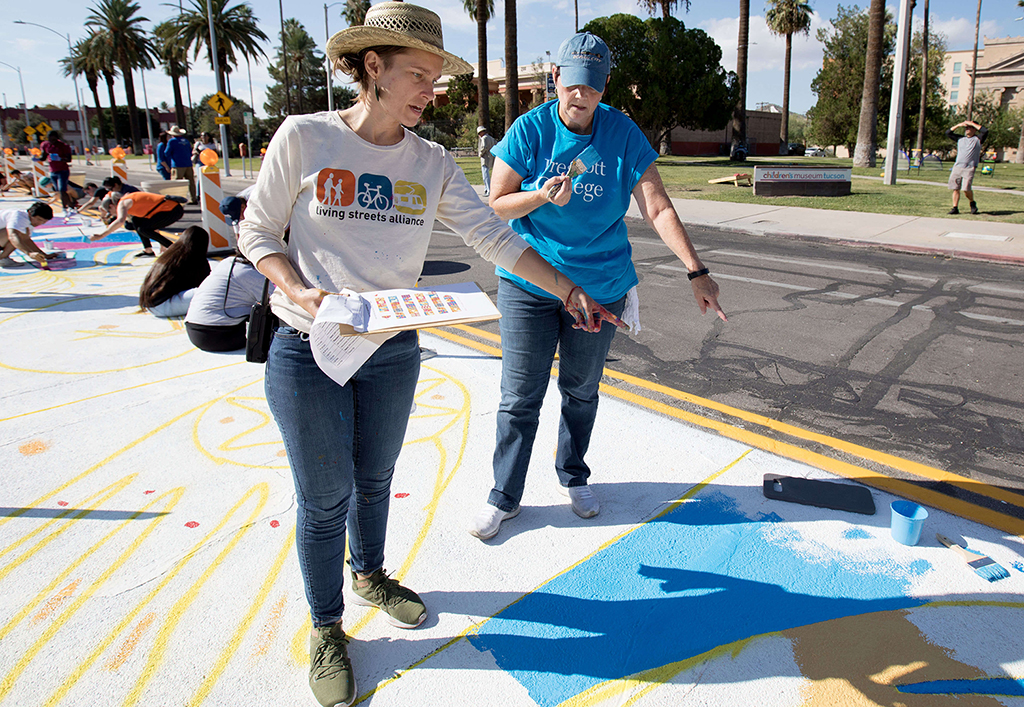
Complementary programming
Consider including a combination of activities that will help energize the implementation activity like local food vendors, performances, or other pop-ups. If there is an existing festival or event nearby, consider aligning the painting day with it.
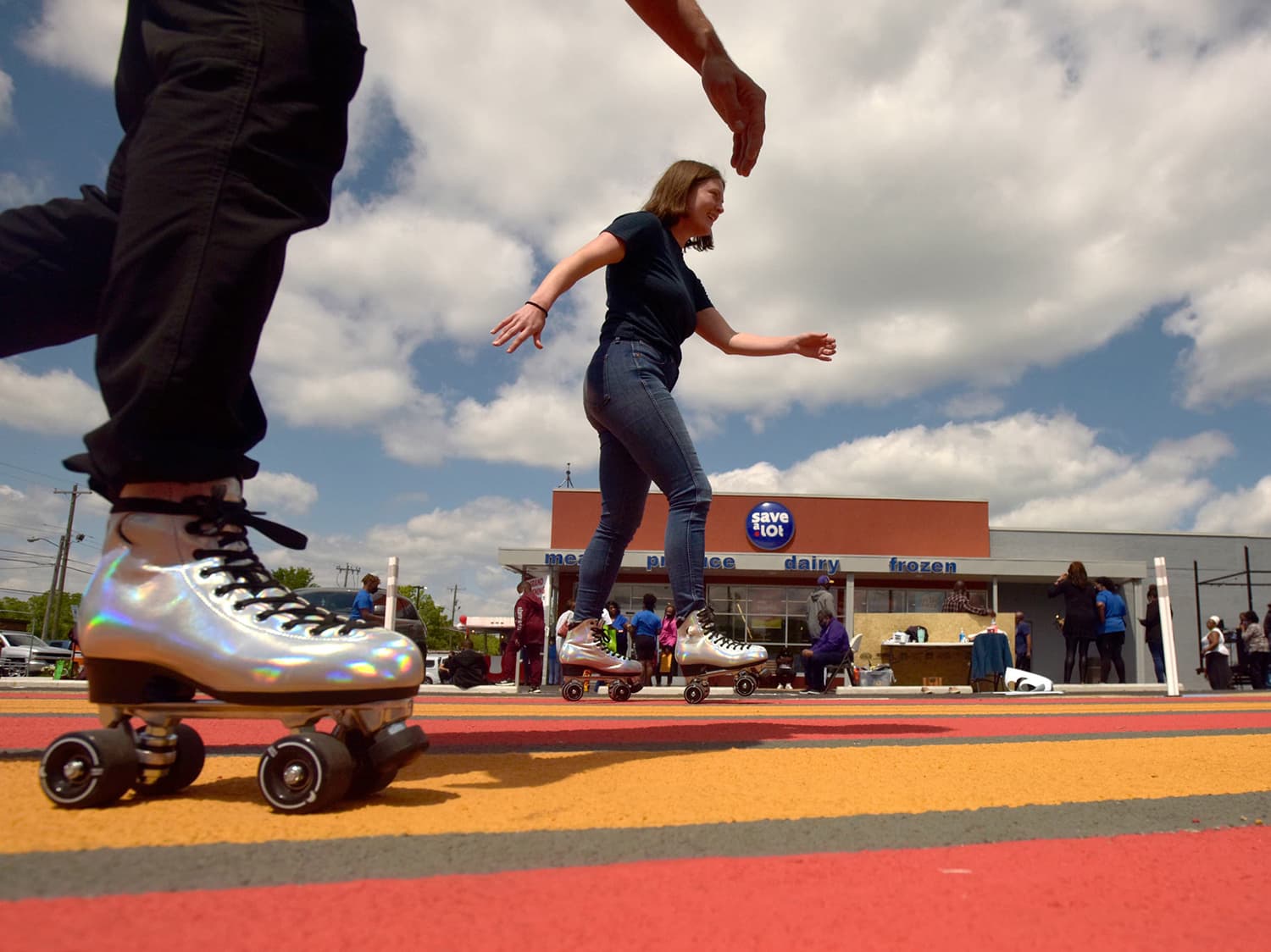
This content was produced by Bloomberg Associates in collaboration with urban planning and architecture firm Street Plans Collaborative.
Header image credit: City of Tucson Department of Transportation & Mobility
How should I collect impact metrics?
It is important to monitor the impacts that asphalt art projects have on both street safety and the way people use and experience public space. Project teams should establish an evaluation plan early in the process to identify what they are most focused on and how they intend to collect data before and after the project is implemented.
Center data collection efforts on what the project is ultimately trying to accomplish. For example, is it improving pedestrian safety? Encouraging more people to spend time in a public space? Supporting nearby businesses or community programming? Expanding the capacity of the local arts community?
In all cases, the question or data set being collected should be the same before and after the project in order to make an accurate comparison. When possible, collect data at similar times of day, days of the week, and weather conditions.
See our List of Common Metrics for ideas for what to collect to understand how well a project meets its goals.
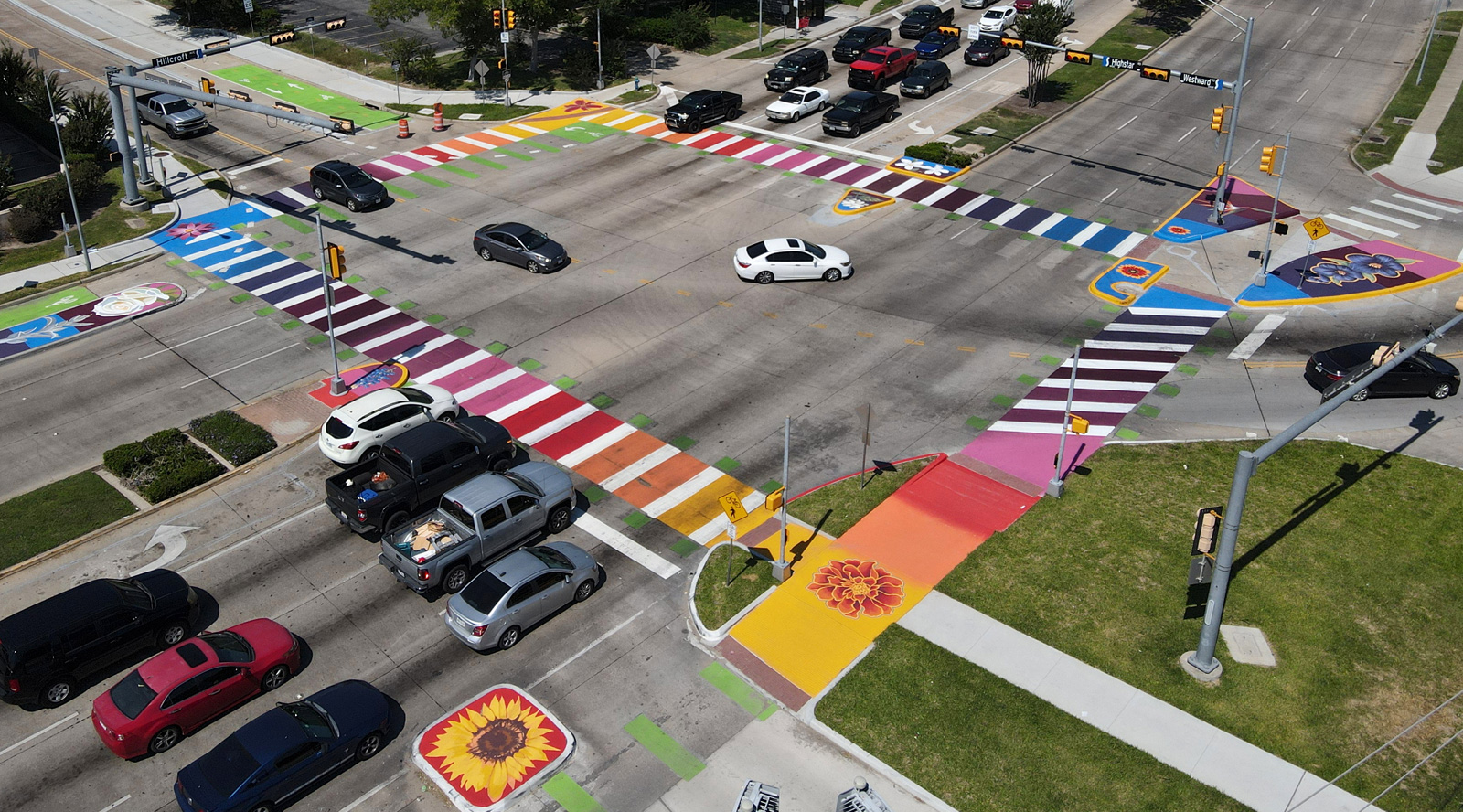
Safety Metrics
Tracking safety-related data can require effort and technical capability, but it can be critical in understanding how a project is impacting the conditions of the street for its users. It typically involves collecting quantitative data related to vehicle speeds, traffic volumes, pedestrian activity, bicycle activity, and crash history. It also requires establishing solid baseline data prior to installation in order to assess what has changed once the artwork is installed.
Some typical safety metrics include:
Car speed
A simple speed gun can work for spot counts inexpensively, or work with a local police department on a more robust speed study across several days.
Crossing behavior
Observation or video analysis can help track how pedestrians move through the project area, whether drivers yield to them, and any visible conflicts or near misses.
Crash data
Many states collect historic crash data history for previous years, while a local police department may have more recent information.
For examples of projects with documented safety improvements, see the metrics on our Kansas City and Pittsburgh project pages.
Public Space Activation Metrics
Asphalt art projects can also change how people experience and use a street, plaza, intersection, or other public space. Public space activation metrics can help project teams understand whether the project is encouraging more people to visit, spend time, socialize, or feel comfortable in the area.
Pedestrian volumes
Simple hand counts may suffice, while video or other automated collection methods can work for longer-term counts.
Dwell time & usage
Observation can help document what kinds of activities people are doing in the space and how long they stay.
User perception
Surveys, focus groups, or interviews before and after the project can capture changes in user experience, specifically comfort and sense of safety.
See our Sample Survey Questions for inspiration on collecting user experience and other qualitative data.
Read more in the Asphalt Art Guide
See pages 100-101 for reference
What are the best ways to document the finished project?
Asphalt art is about visual interventions, and one of the best ways to explain the impact of a project is through images of the site being used. At the start of a project, develop a documentation plan that anticipates desired shots, including angles and times of day.
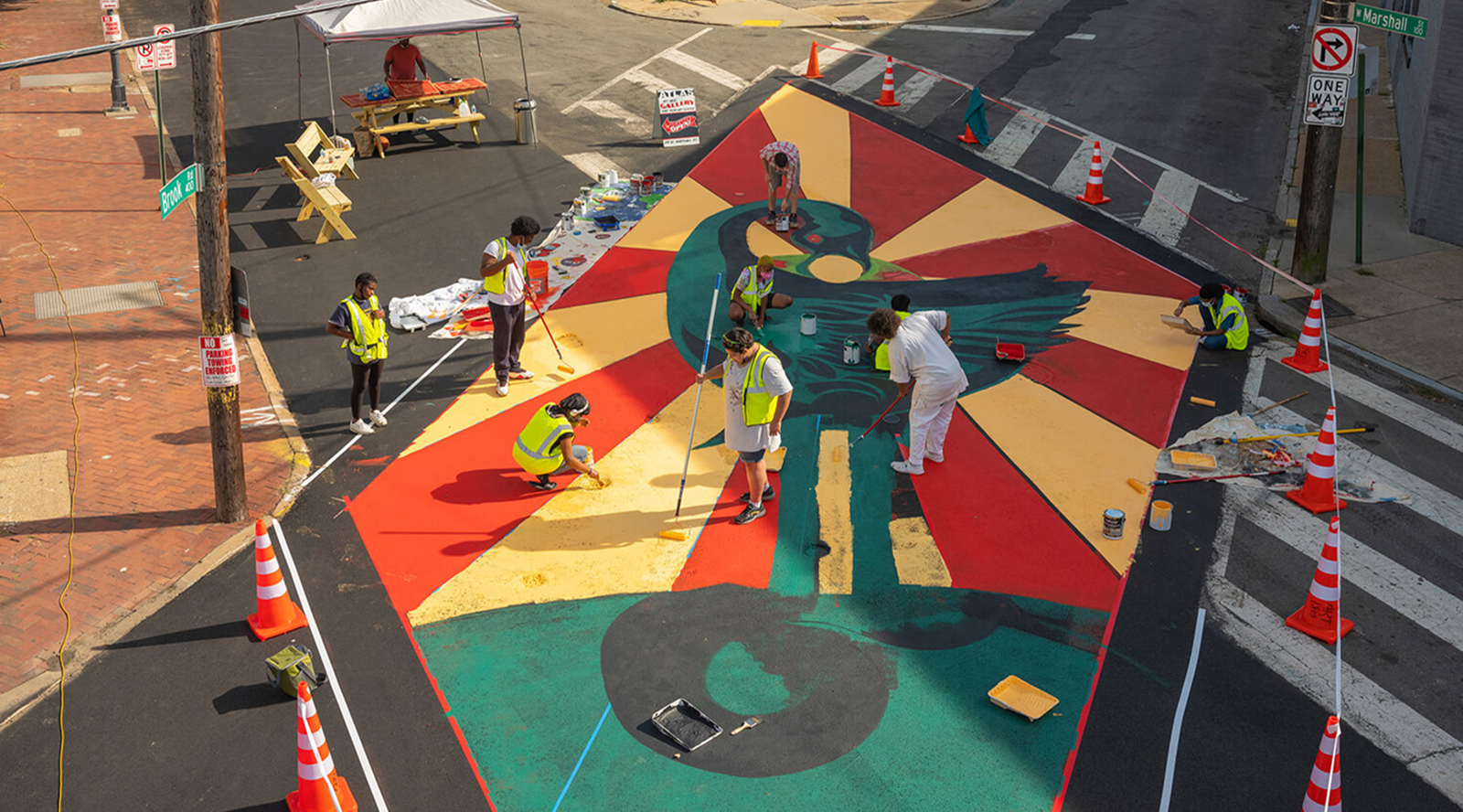
Here are a few additional suggestions:
Before and After Comparisons
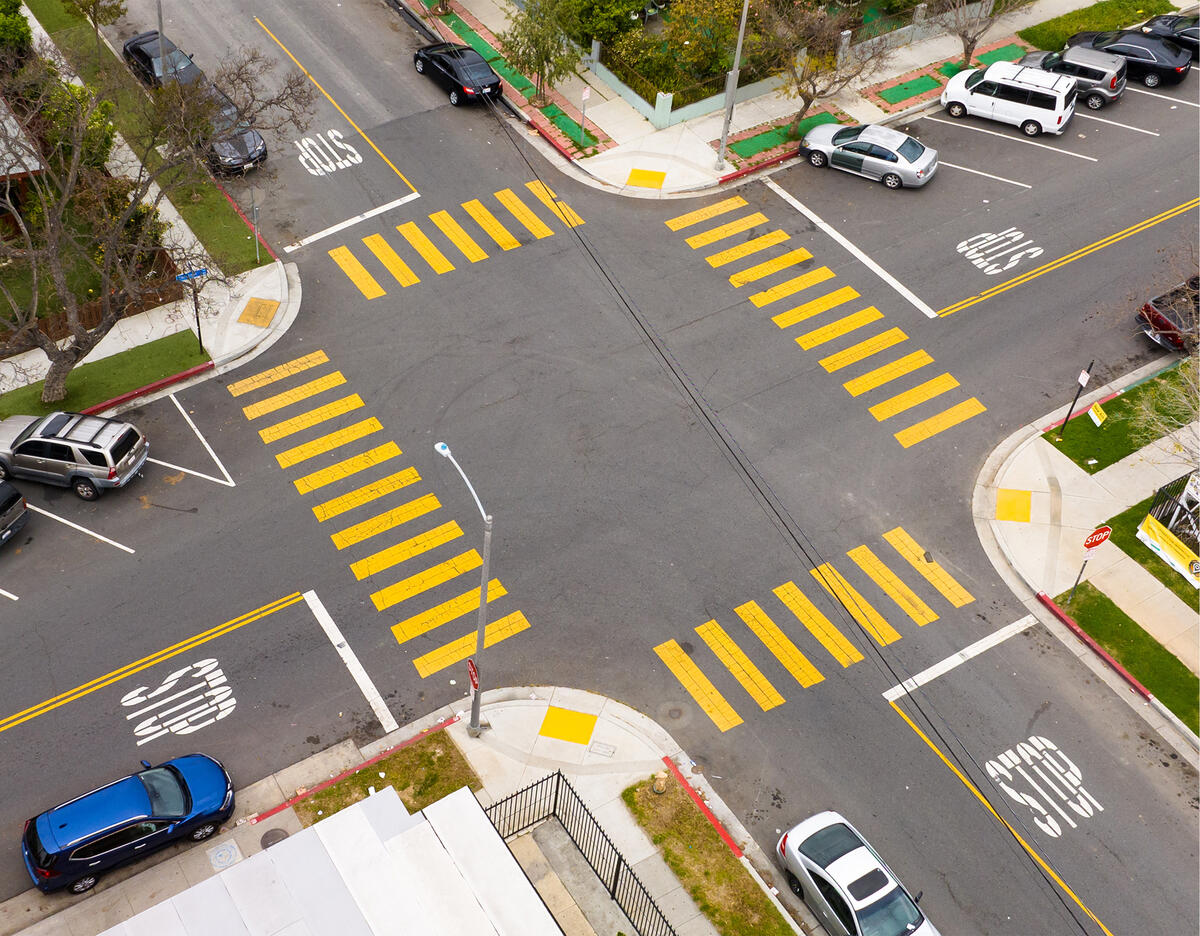
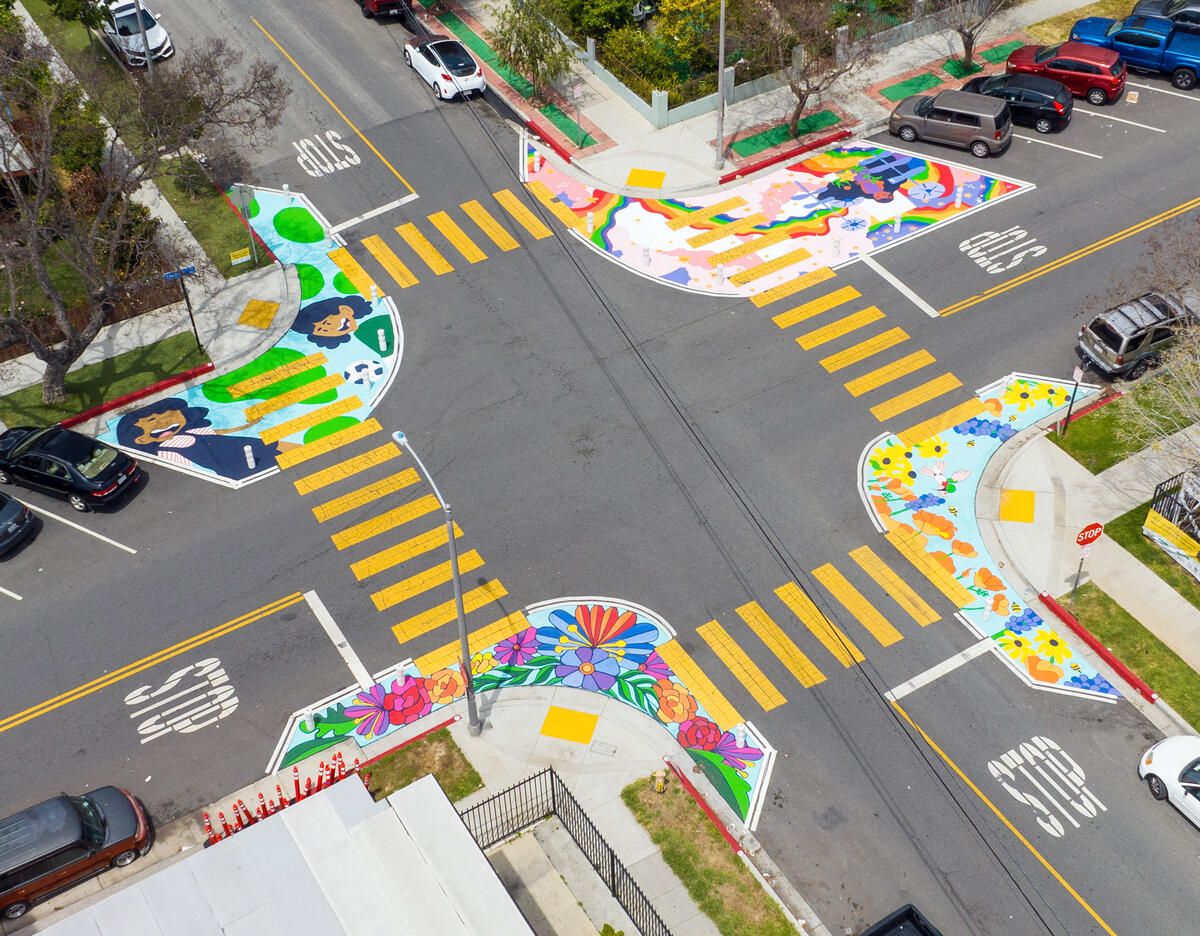
One of the most powerful visual assets are before and after shots taken from the same location and preferably at the same time of day. Consider creative ways of getting the best shots. Aerials taken from drone cameras work best for showing a design in its entirety. Other common techniques include using a bucket truck or getting access to the roof or high point in nearby buildings. If the photos are taken from the exact same angle, they can be used for fun transformation visuals, such as an interactive slider.
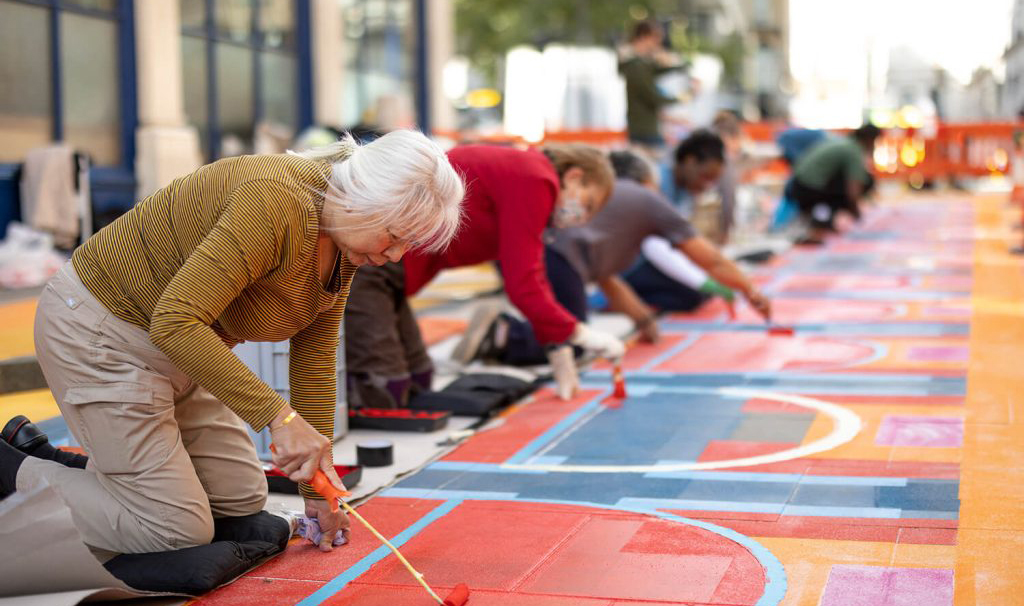
Process Photos
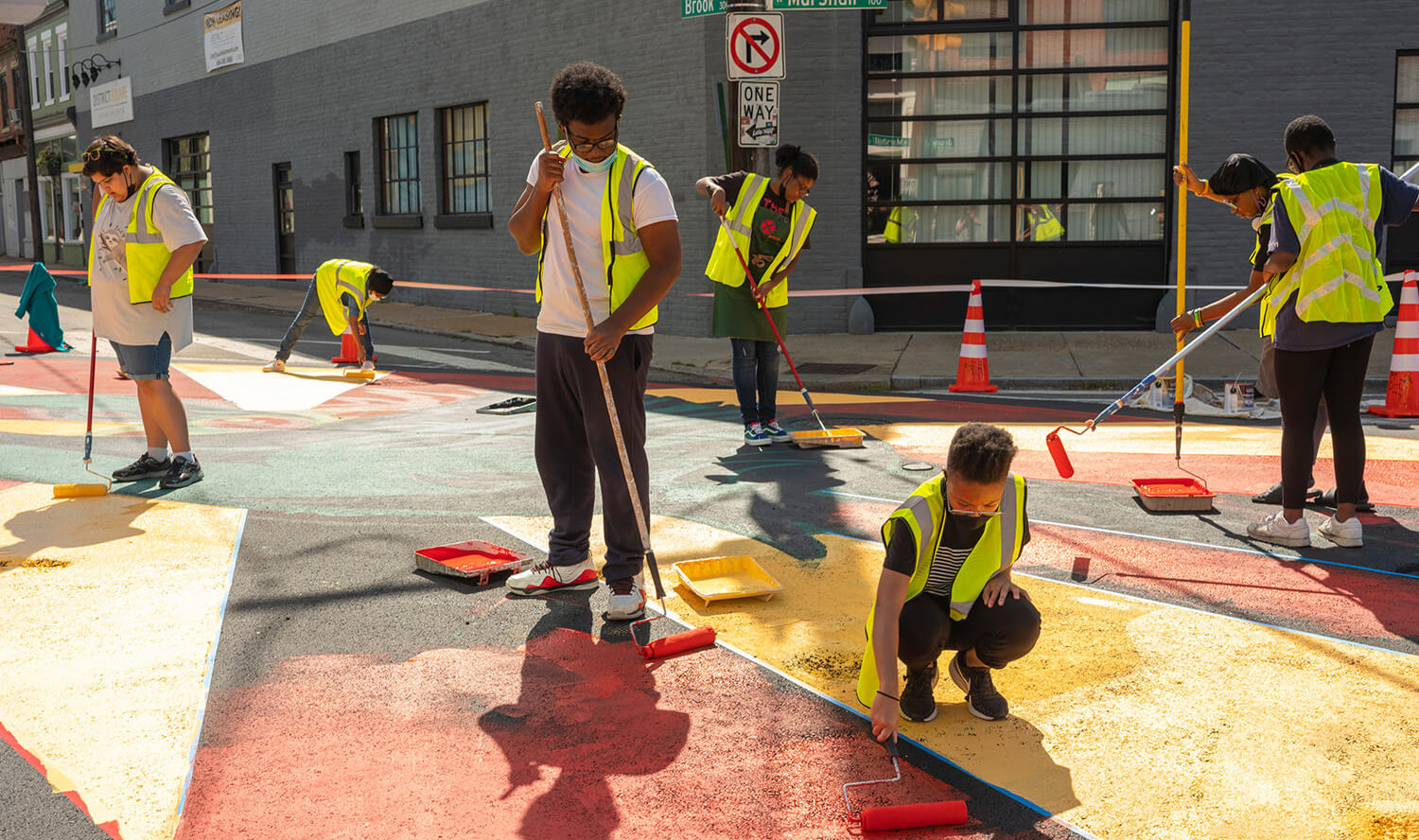
Getting shots of the painting process and community engagement events can be a great way of showing many different community touchpoints.
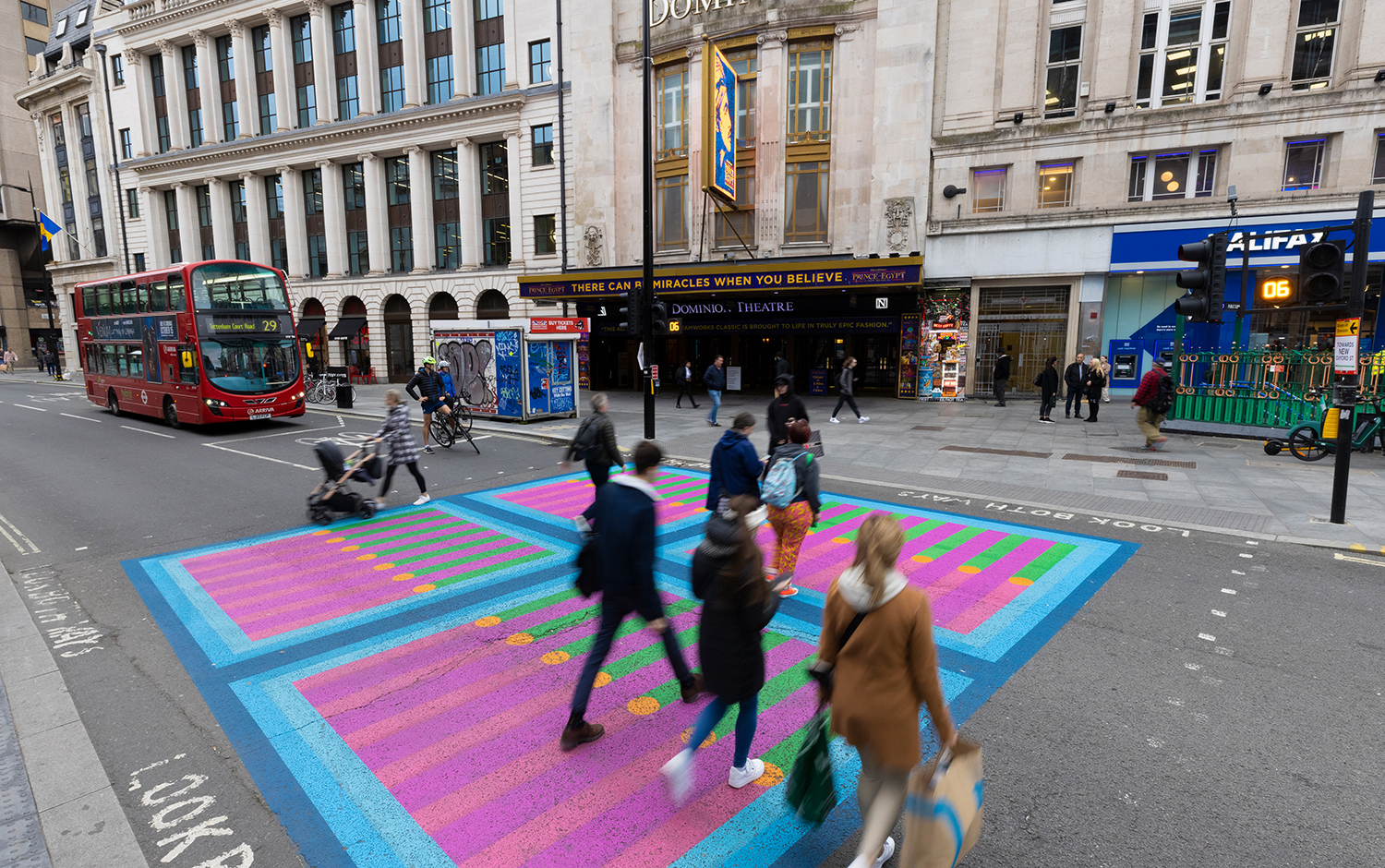
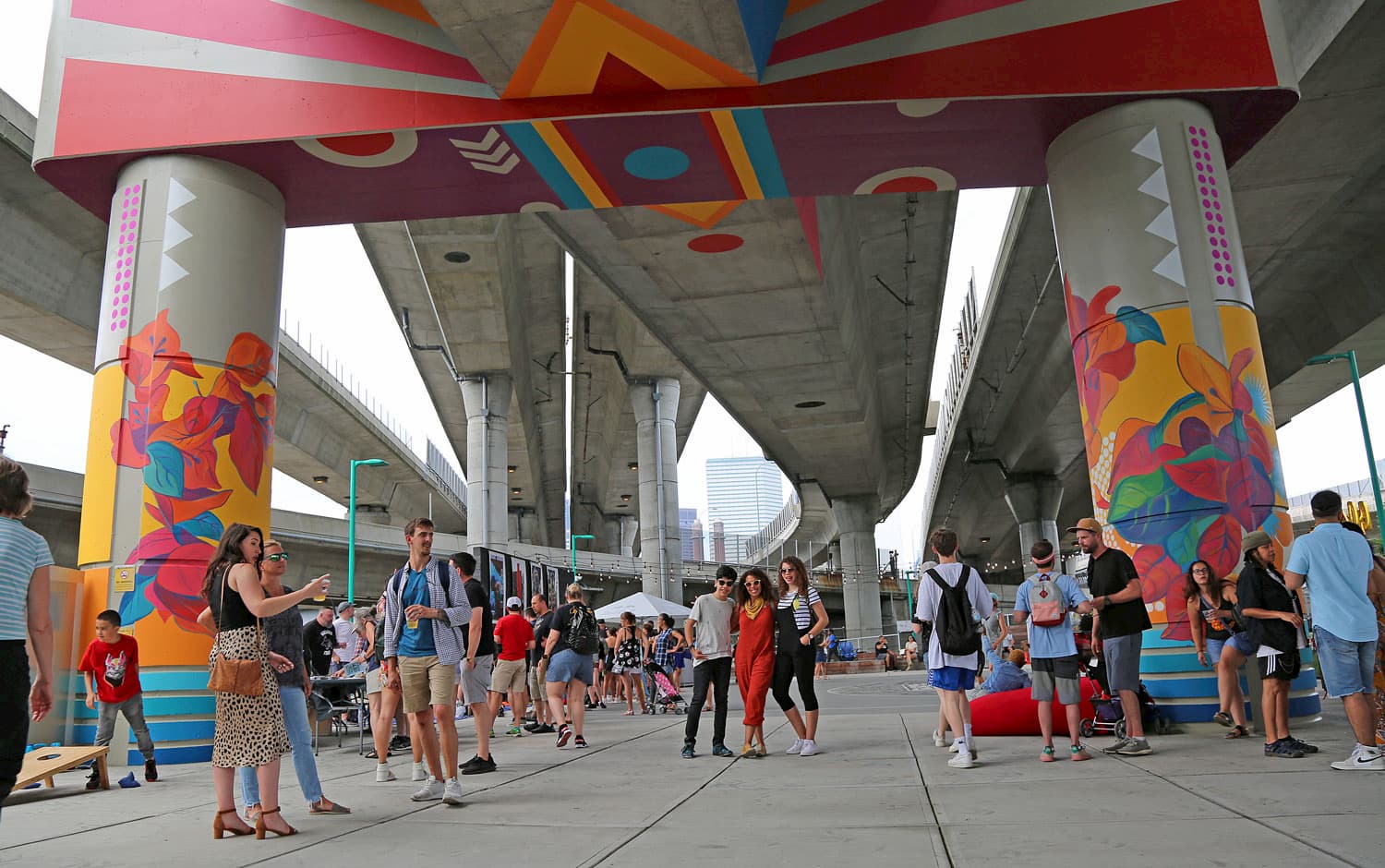
Usage Photos
Getting images of the finished artwork is important, including shots with people moving through the transformed space. Choose times when you expect the site to be particularly bustling in order to capture it at its most active.
Video
Consider taking videos of the work in progress or interviews with artists, engineers, community representatives, and passersby.
See more sample videos on our Gallery page here.
How can I keep the project looking good over time?
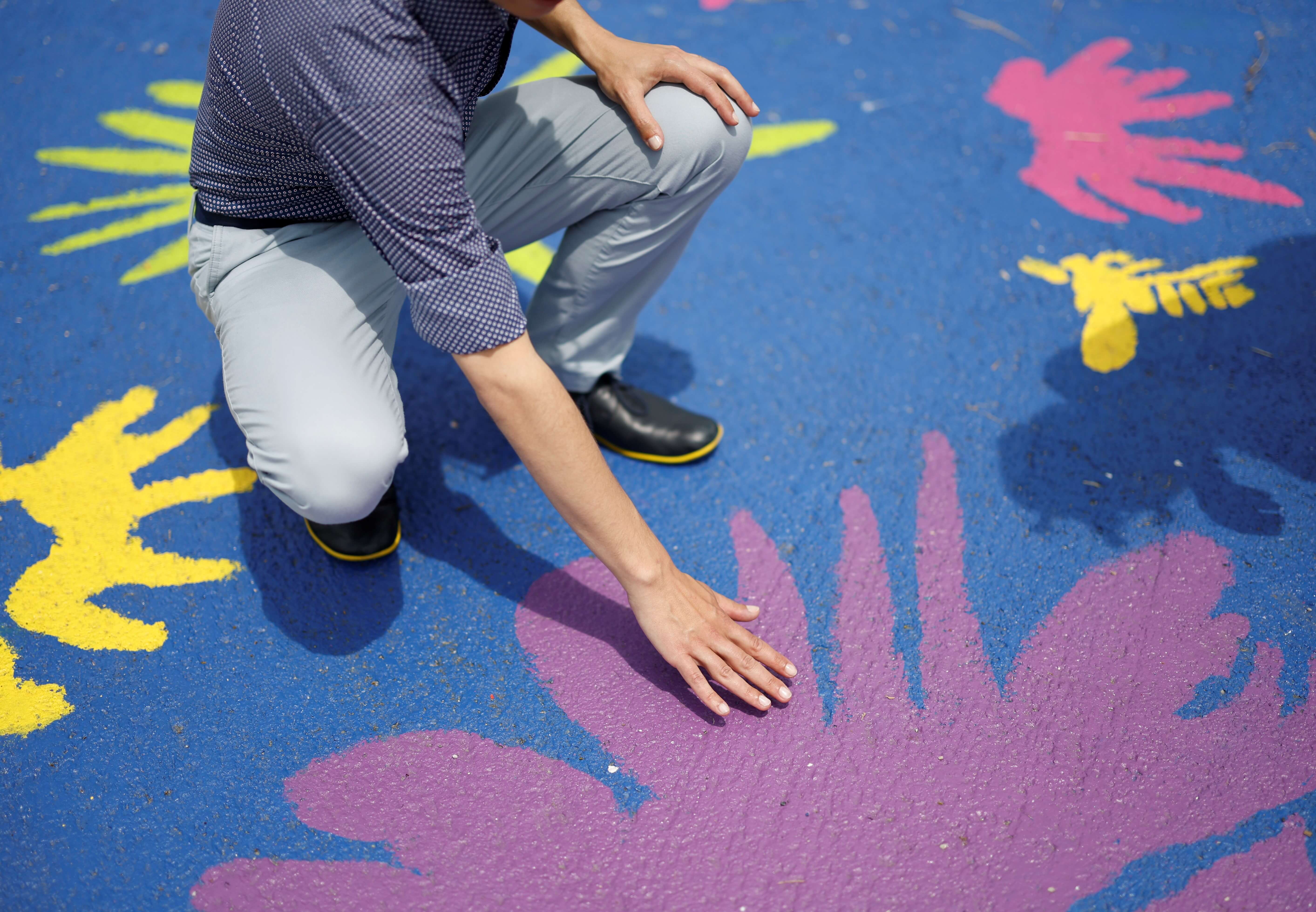
In making decisions about paint type and durability, project teams need to consider a maintenance plan for the site.
Here are some considerations:
- Is there a public space maintenance / programming partner who will be responsible for the space? If so, will they want to pressure clean the space on a regular basis? This will impact the type of paint chosen.
- If a mural is particularly beloved by the community, consider a yearly touch-up routine. Be sure to document the exact paint colors, and keep copies of the templates / stencils used, if any.
- Don’t be afraid of removing a mural if it starts to look bad. Peeling and faded artwork can sometimes look worse than an empty space.
While asphalt art projects are generally temporary, there are things teams can do to maintain them and increase their durability. Properly cleaning the site prior to painting is a good start. Once that is done, consider applying a fixative base coat that promotes paint adhesion. Different paint manufacturers will have products that accompany their paints. On the back end, consider a clear sealant coat on top of the asphalt art paint. This top coat should go on thin to prevent the mural from taking on a cloudy look. It is very important that the paint cure for at least 24 hours before allowing vehicles or foot traffic. Areas with constant vehicular traffic will fade at a quicker rate and may require yearly touch ups.
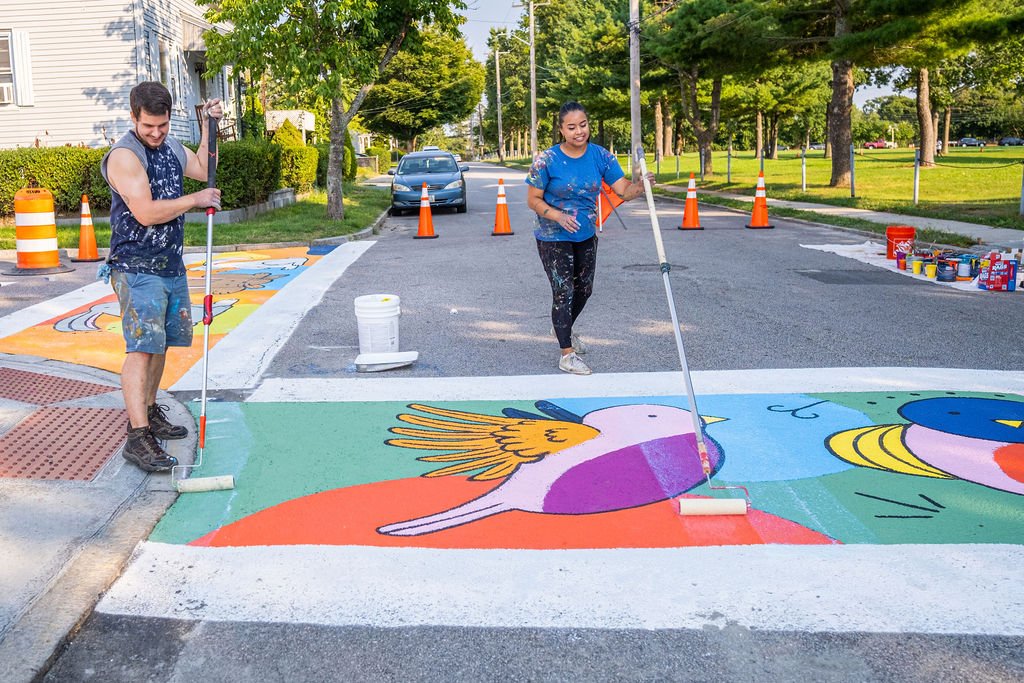
The most important thing for project teams is to set expectations with the community about the long term plans for the site. Will there be permanent curb extensions to replace painted ones? Will permanent pavers replace a painted crosswalk or intersection mural? If the site can become a canvas for changing work, consider a regular program of repainting it with new designs. In Philadelphia, for example, The Oval is a public space delineated by a mural repainted each year by a new artist. This is both a great way to give a greater number of artists exposure on a prominent site, and to provide a built-in maintenance mechanism.
Read more in the Asphalt Art Guide
See page 97 for reference
This content was produced by Bloomberg Associates in collaboration with urban planning and architecture firm Street Plans Collaborative.
Header image credit: City of Tucson Department of Transportation & Mobility